This guide breaks down what institutional investors look for in a pitch deck, from clarity of strategy and team credibility to transparency and risk discipline, and shows how to present your fund in a way that earns their confidence and capital.
Oct 7, 2025, 12:00 AM
Written by:
Niko Ludwig

Table of Contents
Key Takeaways:
Institutional investors judge credibility quickly. Clear, data-backed pitch decks that communicate strategy, discipline, and track record earn attention and trust.
Structure and logic are non-negotiable. Lead investors through your thesis, execution capabilities, and performance evidence in a sequence that supports decision-making.
Transparency builds long-term confidence. Detailed fund economics, governance standards, and risk management frameworks signal operational maturity to allocators.
Differentiation is essential. Define your competitive edge through quantifiable results, sector depth, and repeatable value creation processes.
Professional presentation reflects institutional quality. Precision in language, consistent visuals, and verified data reinforce confidence in your ability to manage capital responsibly.
Institutional investors assess hundreds of opportunities each year under compressed timelines. In that environment, the quality of a pitch deck can be decisive in securing a meeting or advancing through the fundraising process.
Research shows that 42% of LPs rank material quality and transparency among their top three selection criteria. Another study tracking more than 500 LP–GP interactions found that 65% of investors cited clarity and completeness as the primary driver of initial meetings and follow-ups.
For allocators, the deck is often the only lens into a manager’s discipline. That is why a weak presentation can carry serious risks.
The Risks of Failing to Deliver an Outstanding Pitch Deck
Institutional investors make rapid judgments about fund managers based on presentation quality, creating lasting consequences that extend far beyond individual meetings.
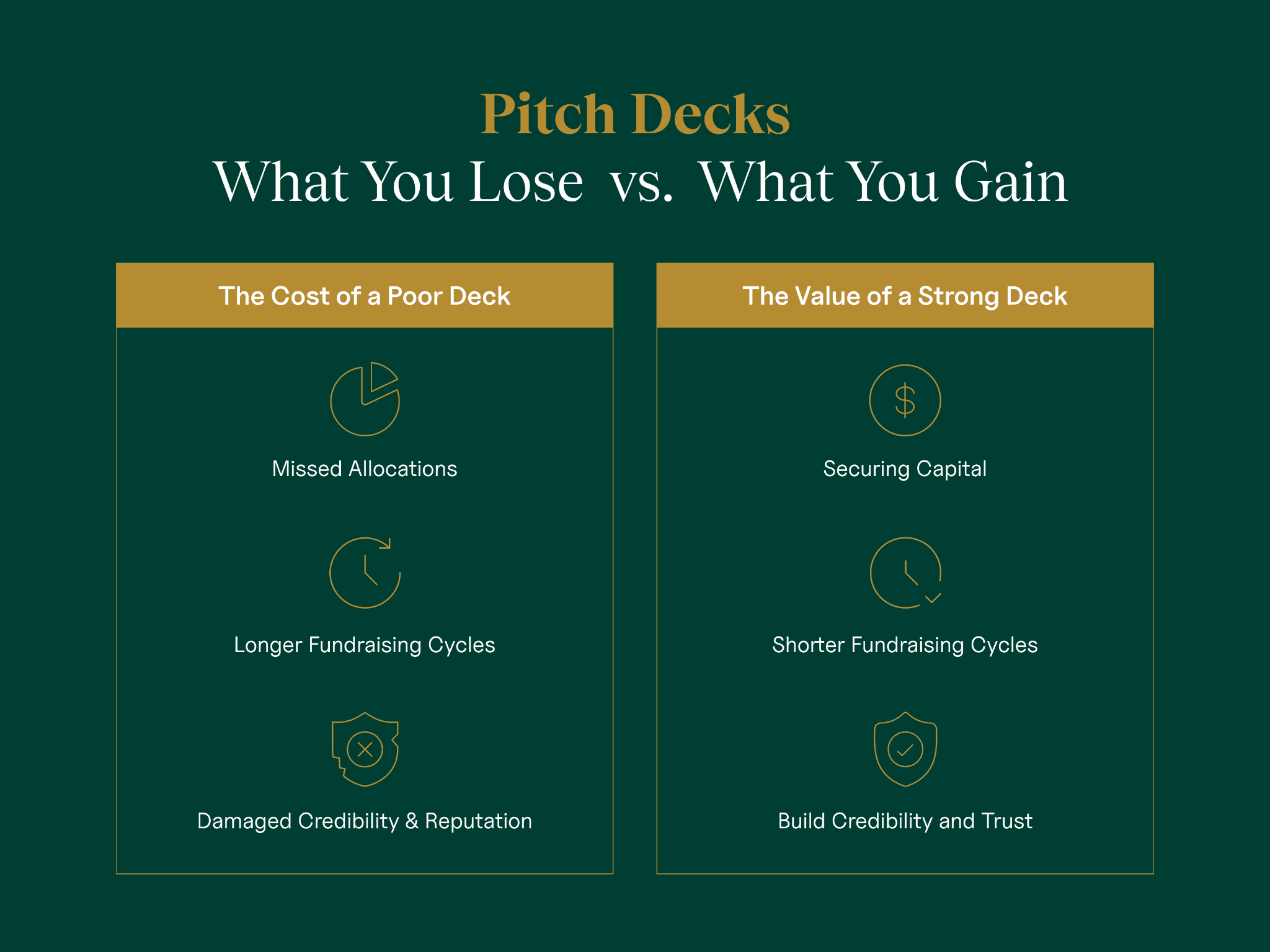
Missed allocations
Even funds with proven track records can lose capital commitments when their decks fail to communicate value effectively. Material quality directly impacts allocator decisions.
The opportunity cost compounds when strong strategies lose allocations to competitors with superior materials.
Extended fundraising cycles
Poor presentations trigger repeated revisions and additional investor requests. What should be efficient capital raising transforms into expensive, protracted processes that drain management attention from investment activities.
Damaged credibility and reputation
Sloppy or unclear materials signal weak execution to institutional allocators. Presentation quality is often taken as a direct reflection of a manager’s ability to operate effectively. Even a strong track record can be overshadowed if the presentation undermines confidence.
Once credibility is damaged, regaining investor trust is slow and difficult. A poor first impression lingers and can limit future fundraising opportunities.
In a crowded fundraising market, the quality of your deck's structure often decides who gets a second meeting. Avoiding these risks starts with structure. A well-designed deck guides allocators through the logic of your strategy step by step.