Key takeaways
Investor reporting builds trust as much as it reports performance. Clear, consistent updates are a running test of a fund’s credibility and directly influence LP confidence and re-investment decisions.
Operations are marketing. Strong infrastructure now defines credibility. Independent administration, third-party audits, and proactive compliance signal professionalism long before performance is discussed.
Digital fluency is mandatory. Investors expect seamless access to information. Portals, CRM analytics, and AI-enabled reporting distinguish managers who operate with transparency and agility.
Relationships compound. Fundraising success grows from trust, not transactions. Genuine communication, prompt follow-up, and consistent transparency turn engagement into lasting partnership.
Adapt or fade. ESG integration, data transparency, and flexible structures are no longer optional. Firms that evolve early will define the next standard for institutional quality.
Raising capital in today’s hedge fund industry is no longer just about performance. Allocators now judge managers on the strength of their operations, transparency, and ability to scale responsibly. Since 2020, tighter regulations, digital due diligence, and evolving investor expectations have rewritten the fundraising playbook.
This guide explores how fund managers can meet that higher standard: building operational credibility, targeting the right investors, crafting persuasive pitches, leveraging technology and relationships, and navigating the new realities of institutional fundraising.
Understanding the hedge fund fundraising landscape
Before 2020, hedge fund fundraising leaned on performance, reputation and personal networks, with limited digital oversight. Since then, allocators have tightened screening processes, regulators imposed stricter reporting, and digital due diligence became standard. Institutional capital dominates flows while retail participation declined.
The capital environment remains favorable for managers meeting institutional standards. According to a 2025 report, 46% of institutional allocators plan to increase hedge fund allocations over the next 12 months, signaling continued confidence in the asset class. While large firms still attract the majority of inflows, emerging managers are regaining momentum, with sub–$1 billion funds capturing $4.2 billion in net inflows during the first half of 2025 (Source: HFR report).
What it means for emerging managers: Capital is available, but in order to compete, smaller funds must build institutional-grade operations, communicate defensible strategy, and cultivate relationships with the same rigor they apply to portfolio construction.
Building operational trust for successful fundraising
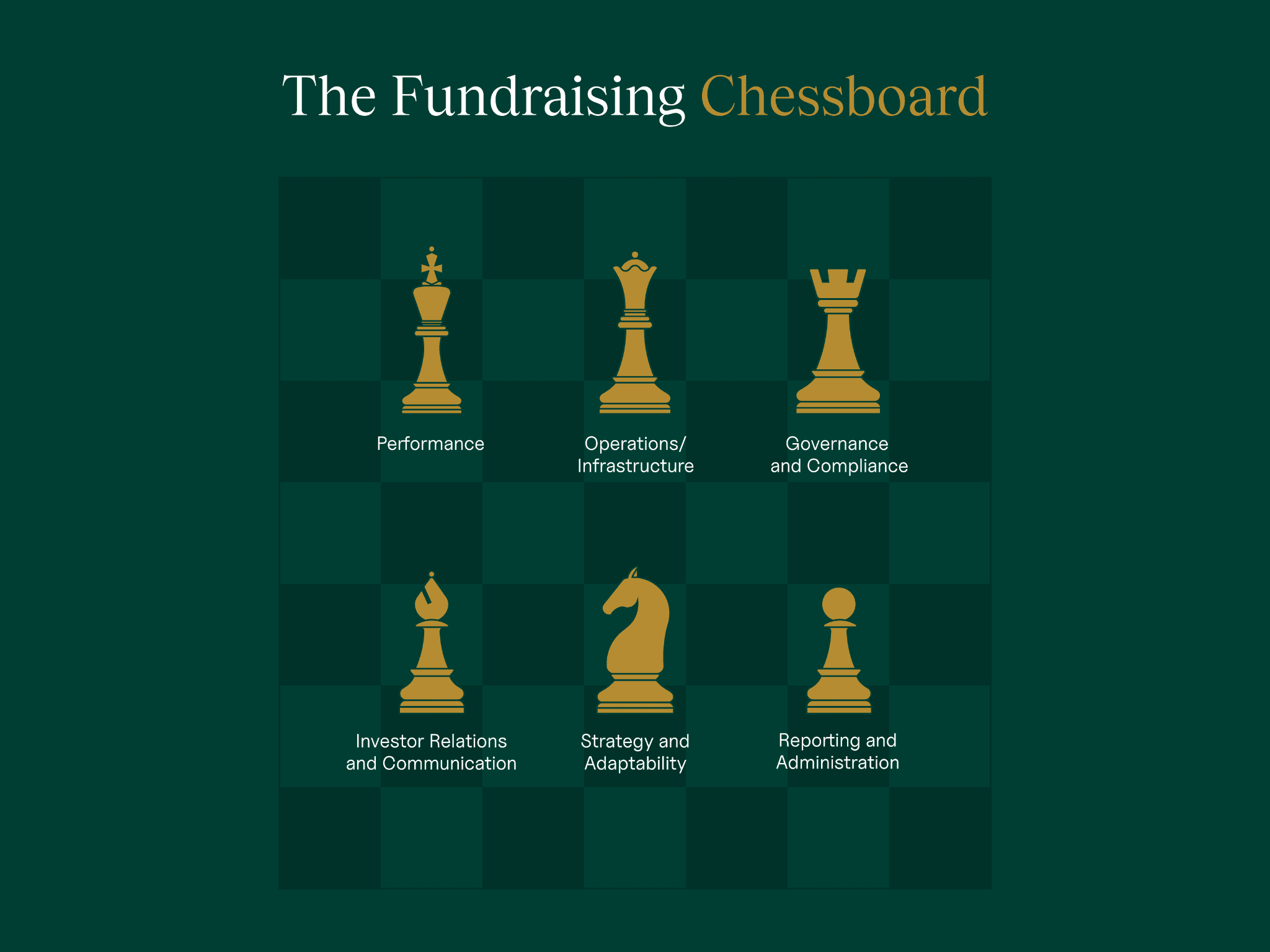
Before investor reporting can strengthen trust, the foundation of that trust must already exist. Even the most transparent reports lose credibility if the fund’s operations, governance, or data integrity are questioned. Investors look first for evidence of control, structure, and discipline, which is the operational proof that a manager can deliver on what their reports promise. This is where trust begins: long before performance is measured or disclosed.
In private equity, strong returns attract attention but operational trust secures commitments. Before any capital is deployed, institutional investors look beyond performance to assess a fund’s readiness, governance, and internal discipline. Operational due diligence often precedes performance evaluation, and weak infrastructure remains one of the leading causes of early rejection.
What builds trust
Credibility begins with sound infrastructure. Institutional investors gain confidence when a fund consistently shows:
Independent fund administration ensuring objective valuations and transparent accounting
Reputable third-party auditor validating financial integrity
Robust cybersecurity and data controls protecting sensitive information and operational systems
Clear, differentiated investment thesis that defines the fund’s edge and how it endures
Documented, repeatable process for sourcing, evaluating, and managing opportunities
Consistent, risk-adjusted performance demonstrating disciplined execution
What erodes trust
On the other hand, operational weaknesses can quickly undermine investor confidence, even when returns are strong. Red flags include:
Opaque or inconsistent reporting that obscures performance, valuation, or cash flow details.
Poor data integrity or weak internal controls leading to errors or unreconciled information.
Key-person dependency without clear succession or governance frameworks.
Reactive compliance or oversight that evolves only under investor pressure.
Unproven or low-quality service providers signaling limited institutional readiness.
Frequent strategy shifts or unclear investment rationale that suggest opportunism over discipline.
Ultimately, operational trust is also sustained through consistency and clarity in how a firm makes decisions and delivers results. Investors look for evidence that the fund’s processes, performance, and philosophy are aligned, reinforcing the same discipline that underpins its operations.
Develop an investor value proposition anchored on Process, Performance, and Philosophy:
Process: How opportunities are identified and risks managed.
Performance: Consistency of risk-adjusted results.
Philosophy: Long-term market perspective and direction.
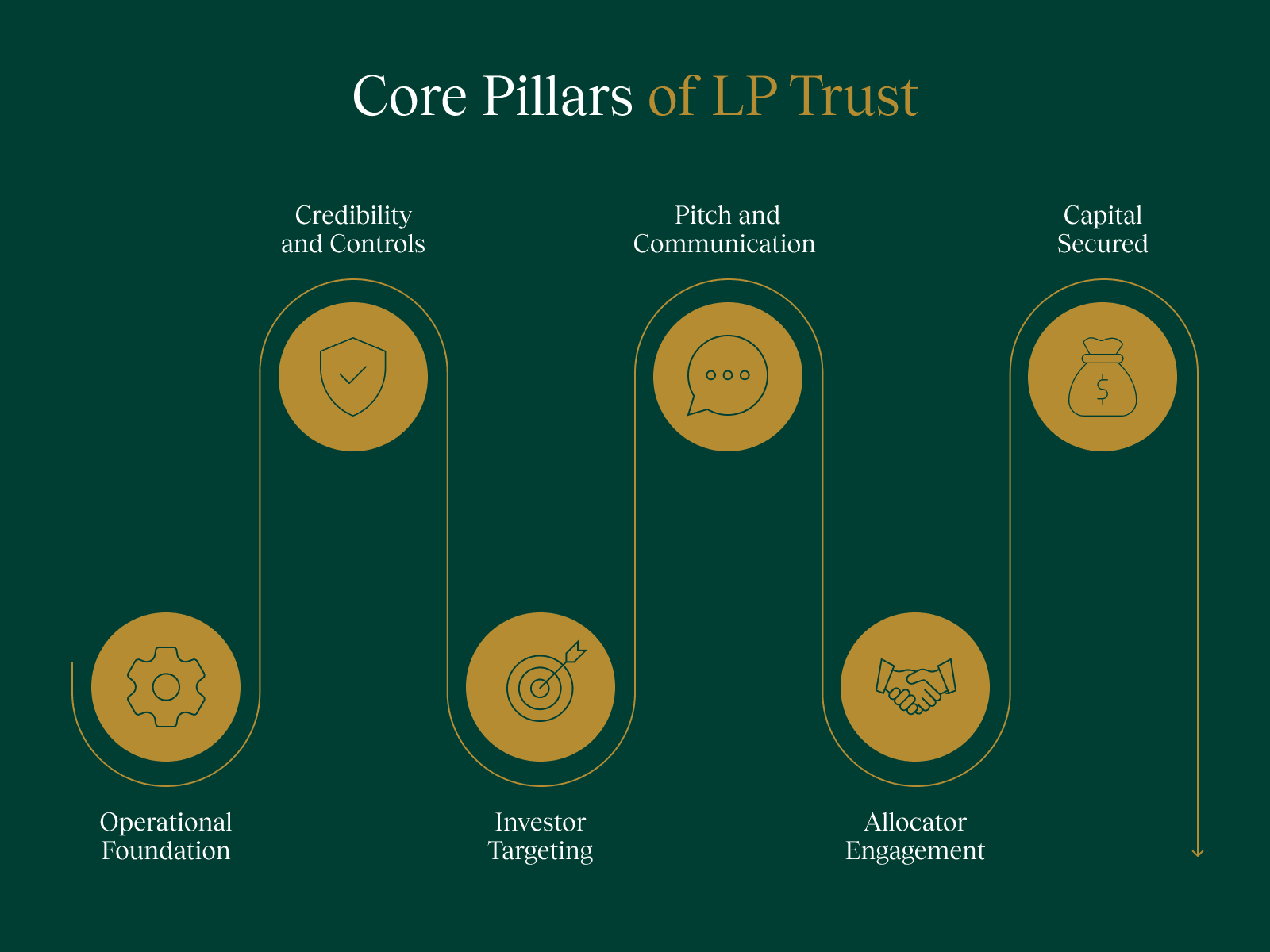
Identifying and understanding your target investors
Institutional investors share high standards but differ in priorities and thresholds. Pensions favor mature funds with proven track records, endowments back skilled managers earlier, family offices value personal relationships, and sovereign wealth funds require institutional infrastructure from day one.
Investor type | Ticket size | Track record | Key priorities |
|---|---|---|---|
Pensions | $25M-$100M+ | 3+ years | Risk-adjusted returns, ESG, fee transparency |
Endowments | $10M-$50M | 1-3 years | Manager skill, mission fit, strategic edge |
Family offices | $5M-$25M | 1-2 years | Relationships, flexibility, communication |
Sovereign wealth | $100M+ | 3+ years | Institutional operations, customization |
ESG and impact mandates increasingly influence decisions. Prepare responses even if your strategy does not explicitly target ESG outcomes.
Crafting a persuasive fundraising pitch
Your opening 30 seconds determines whether an allocator engages. Lead with clarity: state your strategy, edge, and track record without jargon.
A strong pitch deck (15–20 slides) includes:
Executive summary with strategy overview
Team biographies and credentials
Since-inception performance with monthly detail
Sharpe, Sortino, and drawdown metrics
Risk framework and position limits
Service provider list
Fee structure and liquidity terms
Under the SEC Marketing Rule, net returns must be shown alongside gross, with appropriate disclosures. Avoid selective time periods or cherry-picked results.
Although a three-year track record remains the norm, 88% of allocators consider emerging funds if other strengths (such as team pedigree, simulated performance, or robust risk controls) compensate.
Building investor relationships that lead to allocations
While most hedge fund allocations still begin with introductions, allocators now evaluate professionalism through communication cadence and documentation. In other words, relationship management has become a measurable competency. Prime broker capital introduction teams and institutional allocators consistently note that disciplined, well-documented engagement signals readiness far more effectively than aggressive outreach.
Warm introductions through consultants, prime brokers, or existing LPs convert at materially higher rates than cold outreach, especially when followed by precise, timely communication. Allocators expect consistent responsiveness, not one-off enthusiasm.
To systematize this process, treat relationship-building like an operational function:
Implement a CRM to record meetings, contact notes, and next steps.
Send quarterly updates combining both performance data and process commentary.
Document every follow-up, even if no immediate response is received—allocators often review interaction histories during due diligence.
This institutional approach reframes relationship management from etiquette to infrastructure. Allocators want to see evidence that engagement is consistent, compliant, and scalable, a real proof that your firm communicates with the same rigor it invests in risk management.
Digital visibility that signals institutional readiness
Allocators increasingly screen digital footprints before first meetings. Your website, LinkedIn presence, and public materials communicate institutional quality before a pitch deck is opened. Digital vetting has become standard practice: consultants, databases, and OCIOs evaluate how consistently a manager’s digital footprint reinforces their brand and credibility.
Three digital signals consistently influence allocator perception:
Consistency: Ensure your website, pitch deck, and investor materials align in tone, terminology, and metrics. Inconsistencies between online data and presentation materials raise red flags about operational control.
Transparency: Keep investor portals, performance updates, and fund materials current. Stale documents suggest weak communication discipline, undermining confidence before diligence even begins.
Thought leadership: Publish market commentary or research perspectives that demonstrate intellectual clarity without revealing positions. Allocators often cite regular insights as indicators of process maturity and conviction.
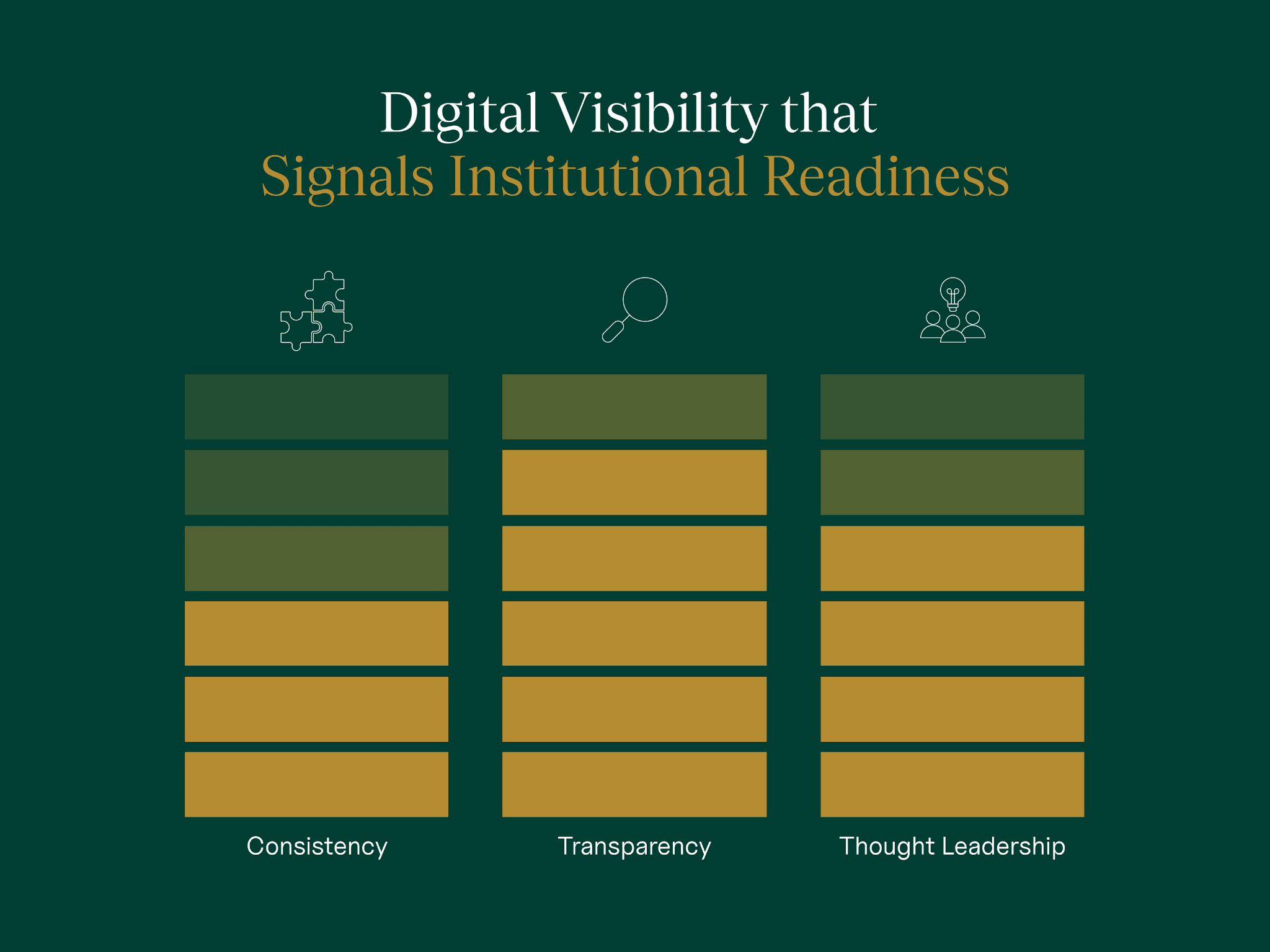
Digital inconsistency (outdated bios, mismatched performance data, or dormant profiles) can erode allocator confidence faster than underperformance. In contrast, cohesive and current digital presentation signals an institutionally prepared firm: one that treats communication as part of its fiduciary standard, not just marketing.
Partnering with external experts
Strategic partnerships can accelerate fundraising, streamline operations, and strengthen institutional credibility. The key is choosing the right partners for the fund’s stage and needs.
Placement agents connect managers with allocators (pensions, endowments, family offices, and consultants) bringing deep relationships and market insight. They typically charge 1–2% of the capital raised and are best engaged once early traction is established.
Fund-in-a-box platforms provide turnkey infrastructure, integrating legal setup, compliance, investor onboarding, and reporting. They help new managers launch efficiently by compressing timelines and reducing upfront costs.
Outsourced investor relations (IR) firms manage communications, schedule roadshows, and track allocator engagement through CRM systems. They become valuable when meeting volume exceeds ten to fifteen per month or when in-house resources are limited.
Other specialists (such as compliance consultants, branding agencies, or technology providers) can further enhance readiness and visibility when coordinated effectively.
What to avoid:
Agents without verifiable relationships
Platforms that lock you into proprietary systems
IR firms that overpromise conversion rates
The right partner accelerates momentum, but you still own the story.
Overcoming common fundraising challenges
Raising institutional capital rarely follows a straight path. Even strong performers face challenges, and addressing them early often determines whether growth accelerates or stalls.
Building credibility without a long track record
Limited track record remains the most cited barrier. 88% of allocators consider funds with three years or less track record when other proof points compensate. Highlight team pedigree, present simulated performance transparently, and implement institutional risk controls early.
Bridging the messy middle
Every successful fund once struggled to land its first allocator meeting, but the harder stage often comes later: the “messy middle” between $50 million and $250 million in AUM.
This gap is too big for seed programs and too small for major institutional mandates. To move beyond it, managers must shift from proving concept to proving scalability, showing that performance holds as assets grow. That requires capacity analysis to demonstrate return durability, operational leverage to prove efficiency, and systematic alpha generation that doesn’t rely on one-off trades. At this stage, allocators look less for promise and more for proof.

Accelerating brand visibility
Brand recognition builds gradually, but deliberate visibility can shorten the timeline. Thoughtful exposure through media placements, industry conferences, database listings, and published insights helps managers stand out in a crowded field. Allocators notice consistency and intellectual clarity; sustained engagement across these channels communicates stability and commitment, even before a formal allocation discussion begins.
Challenge → Solution:
No track record → Team pedigree + simulated performance + risk controls
Messy middle ($50M-$250M) → Capacity analysis + operational leverage + scalability proof
Limited brand → Media + conferences + thought leadership + databases
Small team → Outsource operations + CRM + targeted outreach
Compliance gaps → Specialized counsel + monitoring services
Case studies and lessons from leading hedge funds
Eisler Capital began as a global macro fund, known for its expertise in interest rate and foreign exchange trading. But as returns in macro strategies became increasingly crowded and allocators sought diversification, the firm recognized the limits of a single-strategy approach.
In 2022, Eisler pivoted to multi-strategy and delivered 15.1% in 2022 and 9.8% in 2023. Assets grew to approximately $4 billion by 2024. Alongside this performance, Eisler invested heavily in business development, investor relations, and operational infrastructure. This combination of strategic agility and institutional investment positioned the firm to capture new allocations and build long-term credibility with institutional investors.
More than 500 hedge funds now manage over $1 billion in assets, a milestone that reflects the concentration of capital among firms that scale effectively. These managers share a pattern of strong early performance, alignment with allocator priorities, and sustained investment in compliance, infrastructure, and institutional operations.
What top funds share:
Documented, repeatable process
Consistent risk-adjusted performance
Institutional operations with segregated duties
Transparent communication
Strategic hiring in operations and IR
The bottom line
Raising institutional capital requires more than mere performance. It demands proof of professionalism.
The most successful funds treat fundraising as a process, not an event: prepare thoroughly, follow up deliberately, and adapt constantly to allocator expectations. At Collateral Partners, we help managers do exactly that: transform operational excellence and strategic storytelling into lasting investor trust.