Key takeaways
Polish is now free. So it no longer signals anything.
Candor costs you something. This is exactly why LPs trust it.
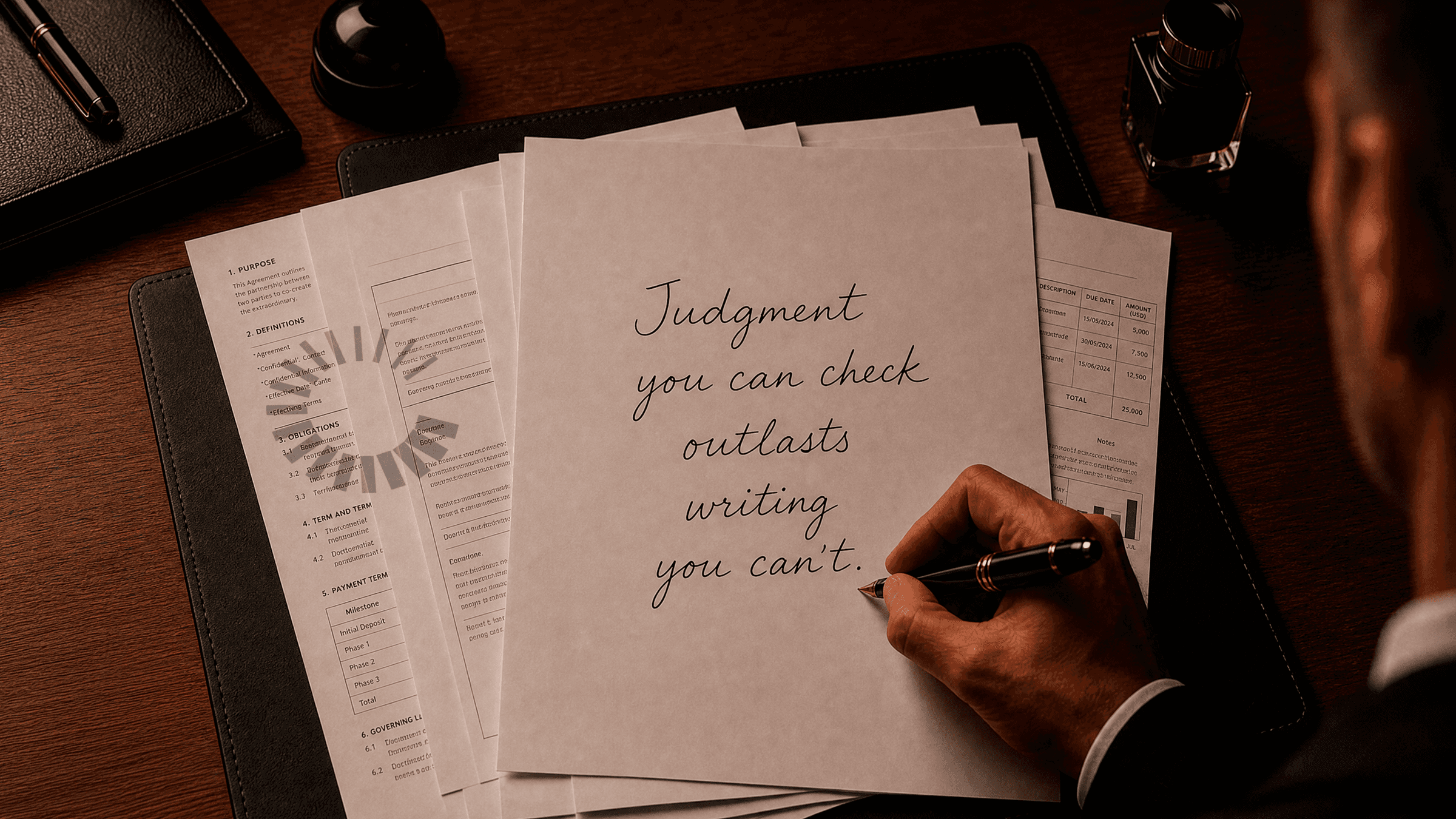
Make claims reality can check. A scored call beats a flawless page.
Keep your name on it. Judgment on the record can't be faked.
The cheaper polish gets, the more it can work against you
The same software now drafts a pitch deck, a quarterly letter, a data room summary and a DDQ response in minutes, and the output is clean. That is the problem. A signal only distinguishes anyone while it stays costly to produce, and where polish once implied effort, a machine-smooth page now gives a reader little reason to assume a partner spent real time on it. It may even invite the opposite suspicion.
Collateral has long argued that allocators read how a fund communicates as a proxy for how it runs money. What it rewards has narrowed to the few things automation cannot supply for free, and those are the parts still worth reading closely.
LPs are now machine-reading your materials back to you
The shift is in how materials are consumed, not just how they are produced. A growing number of allocator teams are deploying AI tools to cross-reference the documents in a GP's data room, systematically, at scale, in ways that a two-person diligence team never could by reading PDFs side by side.
In March 2026, MSCI acquired Vantager, an AI-native platform that extracts and compares unstructured documents issued by GPs in data rooms, generating standardized diligence reports for LPs. Before the acquisition, Vantager had processed thousands of private funds and over 100,000 underlying investments for clients managing more than $100 billion combined.
A CFA Institute framework published in November 2025, The Augmented LP, mapped six stages of the allocator workflow where AI tools now operate. In the diligence stage specifically, it described AI systems that detect inconsistencies across vintages, highlight changes in fund terms, and identify dispersion anomalies in reported returns. In the monitoring stage, those same tools compare current data against baseline diligence, flagging strategy drift, key-person turnover, and operational shifts.
Not every LP team has adopted these tools yet. But the direction is clear, and the GPs whose materials will be read this way first are the ones raising from institutional allocators with the resources to deploy them. Recycled language a human analyst might skim past gets flagged by software running your Q3 letter against your Q1, cross-checking your PPM against your DDQ responses, comparing your current deck to the one you used for your prior fund.
Language that stayed buried in a PDF stack for years can now surface in a structured report before the first meeting is scheduled.
The market price of candor just went up
Most advice treats candor as a steady virtue. What has changed is its relative value. When a growing share of letters read as reasonable, balanced and faintly upbeat, partly because that is what a model produces by default and partly because it is what most managers would write anyway, the willingness to say something costly tends to stand out more sharply.
A glowing self-assessment costs nothing to write and nothing to fake, which is why it increasingly reads as one of the weakest sentences in a letter. Naming a specific misjudgment in front of the people who fund you still carries reputational risk, and a model carries none, which is why manufactured candor reads thin even when the words sound right.
The investors most admired for their writing priced this in long ago:
Warren Buffett built it into Berkshire's owner's manual, warning that an executive who misleads the public “may eventually mislead himself in private.”
Howard Marks has sent candid client memos since 1990, and says he writes to keep ideas “clear and accessible to anyone interested in finance.”
The obvious objection: if allocators are evaluating performance, terms and operational infrastructure, does the quality of the prose actually matter? It is a reasonable pushback, and partly true. An allocator may not consciously score a letter's writing, but CSC's 2025 LP survey found 85% had rejected an investment opportunity over operational concerns alone, and communication quality is how most operational concerns first become visible.
The letter is not being judged as writing. It is being read as evidence of how the firm thinks, and that read was always happening, whether the allocator called it a factor or not.What changed is that the baseline for clean prose moved to zero effort, which left that implicit read with fewer inputs to work from.
Calibration still matters. Useful candor names the weaknesses a sharp reader already suspects and stays inside what you can defend, which is why Collateral treats the right dose of disclosure as the real craft.
A written record compounds in ways a single letter cannot
Candor in any one letter is valuable. A five-year run of candid, checkable letters is a different asset entirely, and the distinction matters now more than it did before AI could produce an excellent standalone piece of writing.
A model can generate a compelling quarterly update on demand. What it cannot generate is a body of work where the October 2023 letter made a specific call on rate exposure, the April 2024 letter reported what happened, and the January 2025 letter explained what the firm changed as a result. That continuity is an institutional record that can only be built by people who lived through the decisions and were willing to put their interpretation on paper at the time.
Each letter that revisits a prior call, states where it landed and what it cost, adds to a cumulative evidence base that an allocator can cross-reference across cycles. That record is what Marks built over 35 years of memos and what Buffett codified in Berkshire's annual letters, both of which are now studied precisely because the claims in them can be measured against what actually happened.
For a manager without that history, the strategic question is how to start building the record that makes the letter five years from now worth something a competitor cannot replicate overnight. "We held our largest position two quarters too long, took a 30% markdown, and changed how we set exit triggers" cannot be lifted from anyone else's letter. That specificity tends to age into evidence. A polished generality rarely does.
The automation boundary most GPs have not drawn
The managers gaining an edge from AI in their investor communications are the ones who have mapped the boundary clearly and automated one side of it without hesitation, while protecting the other.
The low-signal, high-volume work is straightforward to hand off:
DDQ completion
Data room formatting
Performance attribution tables
Compliance language
Standard fund terms.
These are precision tasks where consistency and accuracy matter and where a model often outperforms a tired analyst working at 2am before a deadline.
The high-signal work is everything that requires a named person to commit to an interpretation:
The IC commentary in a quarterly letter explaining why the portfolio is positioned the way it is
The risk assessment that names the scenarios most likely to damage returns
The attribution paragraph that explains not just what performed but what the manager thought would perform and did not and why
These are the sentences a model will produce fluently but cannot stand behind, and they are the ones an LP's diligence tool will compare against the next letter to see whether the narrative holds.
That calculus scales differently by firm size. A three-person emerging manager writing every letter by hand may need automation on the mechanical side more urgently than a platform with a dedicated IR team. The boundary still applies, but where it falls depends on headcount, reporting volume, and how much of the GP's credibility rests on the written word versus a 20-year track record.
The concern is that many firms have not drawn this line deliberately, and the result can be patchwork: some letters entirely human-authored, some entirely AI-drafted, and many an unmarked blend where neither the writer nor the reader can say with confidence which sentences carry judgment and which carry formatting.
Automating the grunt work starves your judgment pipeline
There is a second-order cost that rarely makes the productivity pitch. Junior staff used to build judgment by doing the unglamorous work: constructing the model, drafting the attribution, sitting with messy data until it made sense. Hand all of it to a tool and the work still ships, but the apprenticeship changes form in ways many firms have not thought through.
Allocators have noticed. In Coller Capital's Winter 2025-26 Barometer, limited partners split on whether AI even helps young analysts develop: 44% expected it to help, more than a third expected it to hurt, and the rest anticipated little impact either way. In the same survey, 90% of LPs said an AI model should not have a vote on a GP's investment committee, a plain statement that they want accountable people behind the calls that matter.
The firms most likely to have credible human judgment to put in a letter ten years out are the ones steering juniors toward judgment now, spending the hours automation frees rather than pocketing them.
Allocators will price the distance between your page and your voice
When a written page can be made flawless for free, the unscripted moments carry more weight by comparison. The annual meeting question with no prepared answer, the reference call, the follow-up email written in 20 minutes, these are where a reader now tests whether the polished letter was real.
Nearly one in five LPs say the funds they backed had not communicated strategy clearly, even as operational diligence intensified across the industry. The polished document and the live conversation increasingly need to match, because the distance between them could itself be read as a signal.
A perfect letter followed by a shaky AGM answer reads worse today than it did a few years ago. This weighs most on managers without a long record, where the live moments and the written word are most of what an allocator has to go on.
Bottom line
Has your firm decided, explicitly, which parts of the communication stack carry judgment and which carry formatting, and whether that boundary is visible to the people writing your letters and the LPs reading them?
Three things remain outside what a model can supply and inside what a committed GP can build:
A cumulative written record of specific, checkable calls that can be scored against what actually happened
A junior bench trained to develop the judgment those calls require
Consistency between the page and the room that survives when the prepared script runs out
These are institutional decisions that show up in writing.
Allocator confidence through the next cycle will belong to the firms whose letters can be checked against what actually happened, not the ones whose letters read the smoothest on first pass.
This is the work Collateral does with private markets firms, building investor communications that put real judgment on the record and stand up to the closer read allocators now apply. To pressure test where your own materials carry signal and where they are coasting on polish, speak with our team.