Key takeaways
$957 billion in commercial real estate loans mature in 2025, creating unprecedented refinancing pressure. Banks now account for approximately 40% of total new originations (including agency lending), down from their historical dominance, forcing borrowers to private credit markets.
Private lenders now account for 47.2% of non-agency loan closings, up from 20.2% a year earlier, with major firms like AXA IM Alts and PGIM deploying billions in real estate debt capital.
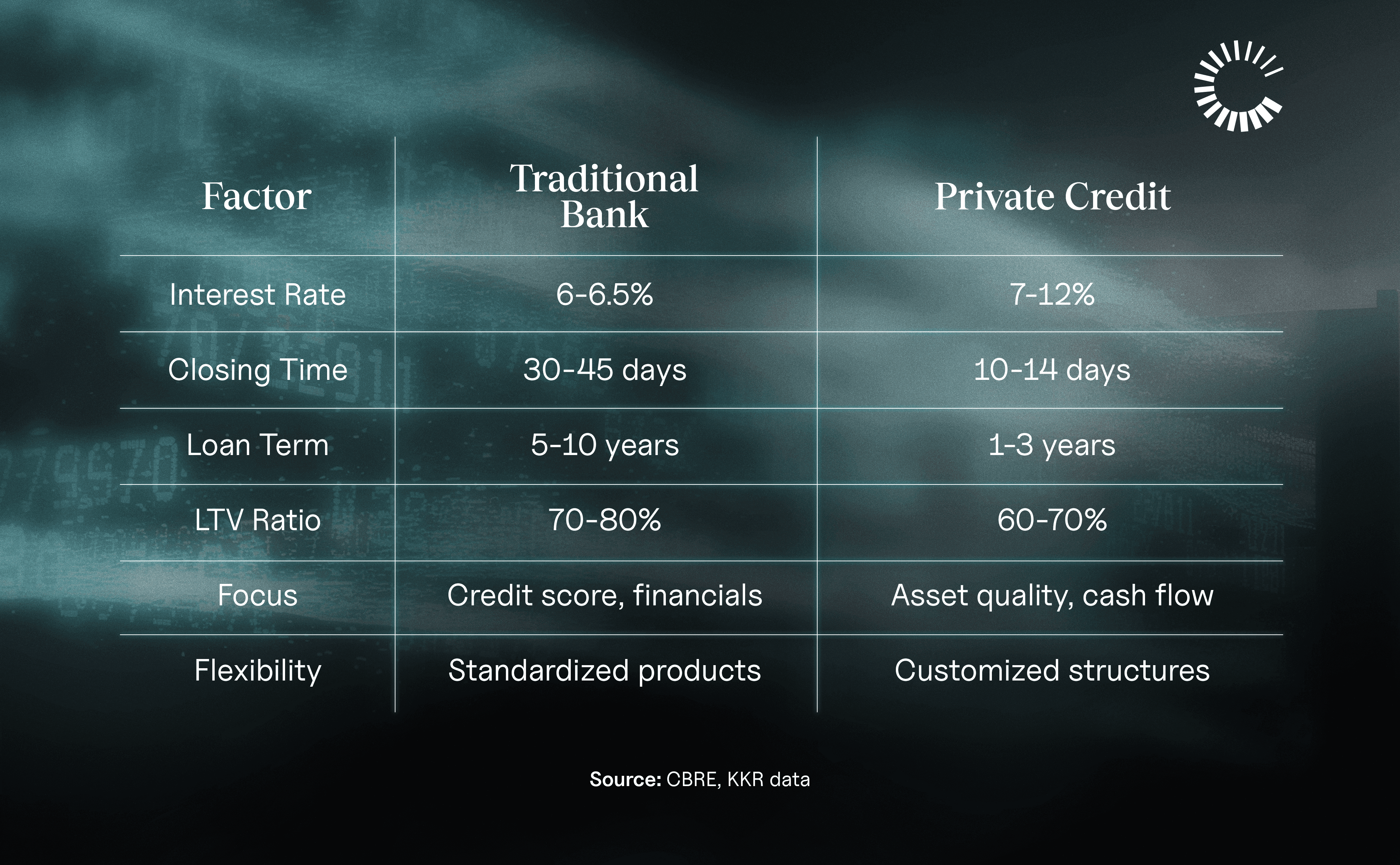
Private credit costs 7-12% but closes in 10-14 days compared to bank loans at 6-6.5% taking 30-45 days, making speed and flexibility worth the premium for time-sensitive deals or transitional properties.
Lenders focus on 60-70% loan-to-value ratios with emphasis on stabilized cash flow, strong sponsorship, and clear exit strategies rather than traditional credit scores, requiring different deal positioning.
This shift is permanent, not cyclical, as banks face ongoing regulatory constraints and capital efficiency pressures, meaning real estate managers must build private lender relationships now, not wait for traditional financing to return.
How private credit became the primary capital source for commercial real estate
The rules of commercial real estate financing have changed, and most managers haven't adapted yet. Traditional banks that once dominated deal flow now provide less than 40% of total new CRE originations (including agency lending), leaving a void that private credit lenders have filled with speed, flexibility, and significantly higher pricing. It has changed how capital flows to properties.
What does this mean for real estate fund managers trying to close deals or refinance maturing loans? This article breaks down how private credit actually works, what lenders look for now, and the specific strategies sophisticated managers use to secure financing when banks say no. If you're fundraising, refinancing, or competing for deals, understanding this shift is vital.

The scale of the refinancing challenge
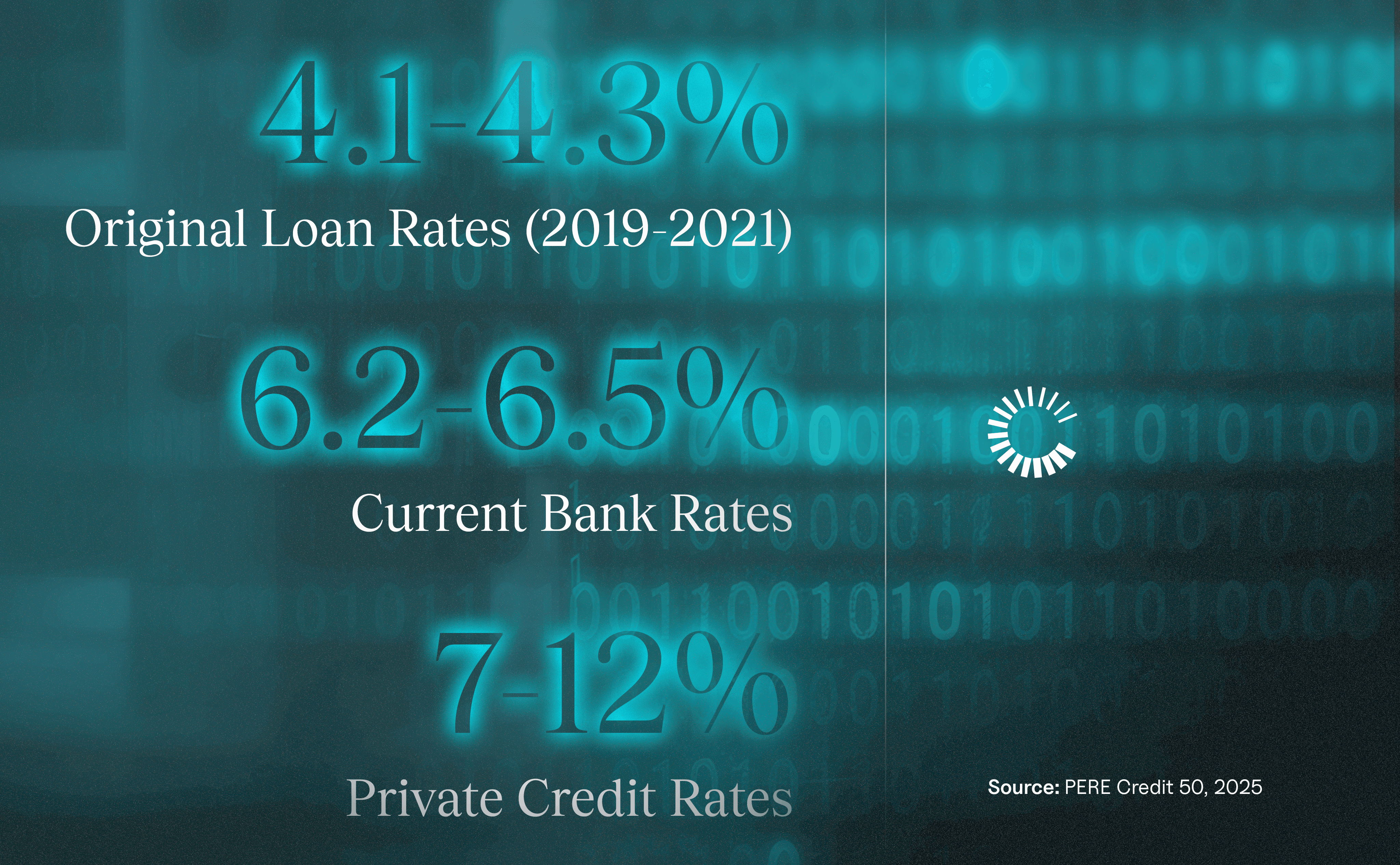
Property owners who financed acquisitions at ~4% now face refinancing at ~6% or higher while valuations have declined. That creates double margin compression: higher debt service against lower asset values.
The Federal Reserve cut its short-term rate target by 100 basis points in 2024, but longer-term rates increased by an equivalent amount over the same period. Borrowers who extended maturing loans in 2024, hoping for rate relief, are running out of runway.
Among loans backed by industrial properties, 22% came due in 2025, as did 24% of office property loans and 35% of hotel loans. Hotels face the steepest challenge, though office properties carry greater concern given fundamental demand shifts. Multifamily remains the largest segment by dollar volume, but capital availability differs sharply across property types.
The maturity calendar doesn't ease after 2025. Roughly $1.26 trillion in loans comes due through 2027—debt that originated when sponsors assumed permanent access to cheap capital.

Why traditional lenders stepped back
Banks held approximately $3 trillion in commercial real estate debt as of late 2024, but banks comprised only 18% of non-agency CRE loan originations in Q3 2024, a sharp drop from 38% a year earlier. The retreat reflects regulatory scrutiny after regional bank failures in 2023, when concentrated real estate exposure became a liability rather than a business line.
Banks are reducing their presence in the market, partly driven by greater regulatory scrutiny. Regulators now examine bank portfolios with particular attention to office exposure and construction lending. Capital requirements for high-volatility commercial real estate loans (construction and heavy value-add deals) carry a 150% risk weight versus 100% for stabilized properties. That regulatory math makes transitional lending far less attractive on a risk-adjusted return basis.
Many banks shifted strategies rather than exiting entirely. They now prefer warehouse facilities and loan-on-loan structures that let them lend to other lenders rather than originate directly. This approach reduces balance sheet exposure while maintaining relationships, but it removes billions in direct lending capacity from the market.
Loan extensions compound the problem. Loans due in 2024 were extended to 2025 and beyond. Banks that extended maturing loans haven't recycled that capital back into new originations. Their loan portfolios are locked in place, reducing the velocity of capital that historically fueled deal activity.
The result: banks now function more as portfolio managers than active originators in commercial real estate.

How private credit fills the gap
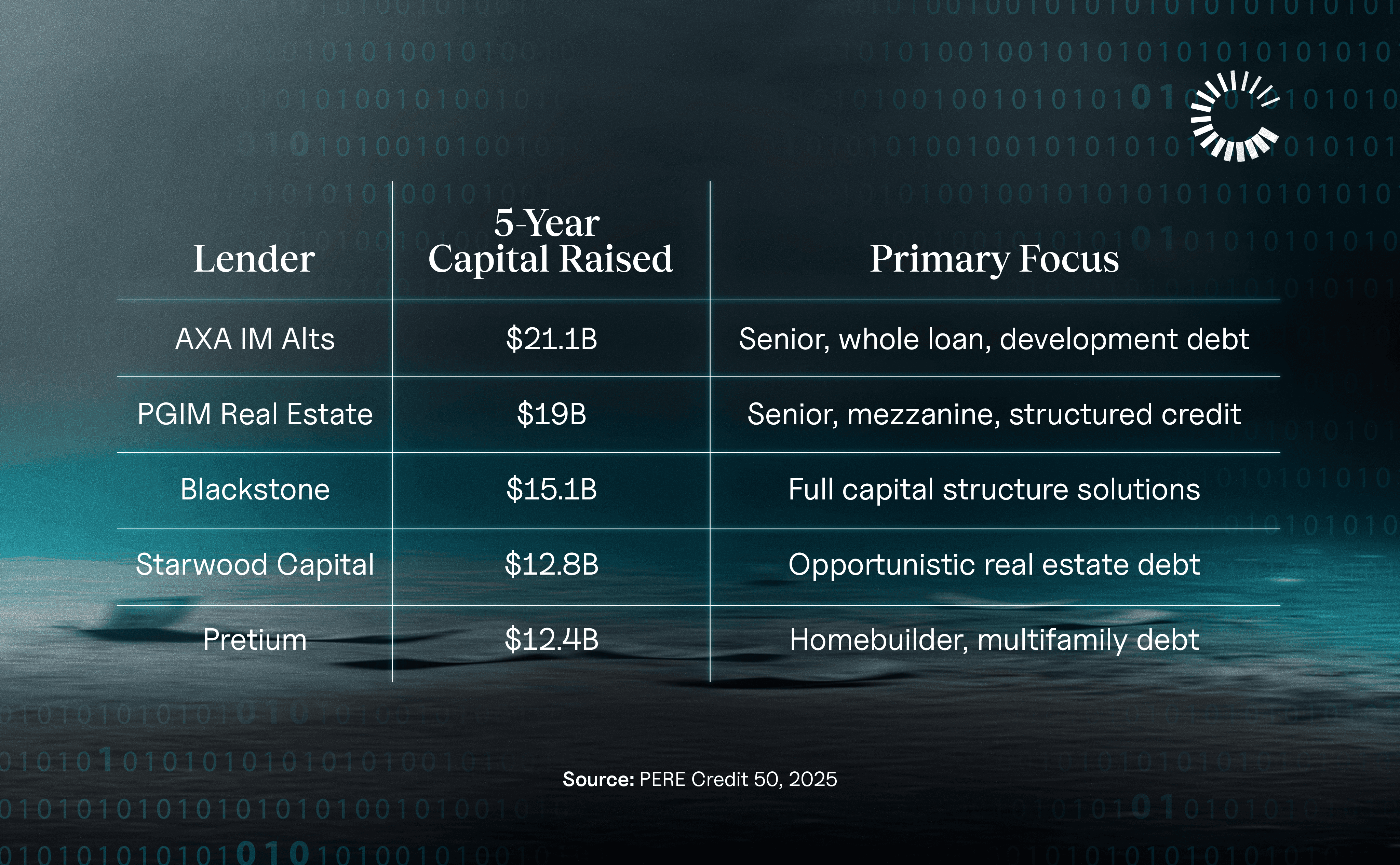
KKR's global lending pipeline has hit $42 billion for the first time, a figure that captures how private capital has scaled to meet institutional-sized financing needs. The major players—AXA IM Alts with $21.1 billion raised over five years, PGIM with more than $19 billion, and Blackstone with $15.1 billion—now operate lending platforms that rival mid-sized banks.
These aren't opportunistic lenders taking advantage of distress. They're deploying permanent capital raised specifically for real estate debt strategies, with multi-year investment periods and the expectation of recycling capital into new loans as old ones mature.
KKR focuses on larger loans, often greater than $400 million, that are low leverage and secured by high-quality, well-located assets within secular growth sectors such as multifamily, and owned by well-capitalized, institutional borrowers. Typical loan-to-value ratios range from 60-70%, more conservative than many bank loans originated during the low-rate environment.
The economics differ fundamentally from bank financing. Private credit typically costs 7-12% depending on leverage and property type, compared to 6-6.5% for bank loans on similar assets. A property generating 7% unlevered returns can still produce attractive levered returns at 6% debt costs. At 10% debt costs, the same property barely covers financing, leaving little equity return unless rents grow materially or the sponsor executes a successful value-add plan.
Sponsors don't treat this as a temporary premium to tolerate. They underwrite deals assuming that private credit is the permanent cost of capital, then treat bank financing as upside if it materializes. That mental shift changes which deals get pursued.
Loan terms create refinancing exposure by design.
Private credit loans run 6 months to 3 years, versus the 5-10 year terms with rate locks that banks historically offered. The implication: sponsors must model their exit before they model their returns and answer these questions:
Will the property qualify for agency financing after stabilization?
Can a bank refinance it?
If neither, what's the disposition path?
Private lenders’ capital recovery depends on the answers. Properties without clear exit paths face higher pricing or outright rejection. Sponsors who can articulate a credible transition to permanent capital get better terms than those presenting a property without a refinancing thesis.
Speed and reporting work together.
Private lenders could close in 10-14 days when terms align, versus 30-45 days for traditional banks navigating committee approvals. That timing difference determines whether deals happen when sponsors compete on acquisitions or face hard maturity dates.
The speed comes with oversight. Most private lenders want quarterly or monthly financials, regular property updates, and direct access to sponsors. They're hands-on because they're deploying fund capital with defined return targets.
Experienced sponsors use this dynamic strategically. The reporting relationship on a first loan builds familiarity that translates into faster approvals and better terms on subsequent deals. A lender who has watched a sponsor execute through lease-up, navigate a difficult tenant situation, or deliver on projections becomes a repeat capital source. Cold outreach to a new lender rarely produces equivalent terms.
Private credit also brings flexibility in structure, for example:
Bridge loans for properties in lease-up.
Mezzanine debt to fill equity gaps when senior debt alone won't cover refinancing needs.
Interest-only periods during property stabilization.
These are practical responses to deals that don't fit standard bank underwriting, and they explain why private credit captures transactions that could otherwise stall.
What lenders look for now
Underwriting criteria have tightened across every dimension, and the metrics that mattered during the low-rate era no longer determine which deals get done.
Cash flow
Lenders size deals to stabilized income, not paper valuations. Debt service coverage ratios now run 1.35x or higher, compared to 1.25x that was common during the low-rate era. Loan-to-value ratios range between 40–80%, but hitting the top of that band requires pristine sponsorship.
Location
This is important and binary:
Urban multifamily in supply-constrained markets attracts capital.
Last-mile industrial near ports or distribution hubs remains favored.
Office properties in central business districts with long-term credit tenants can still find financing.
Suburban office? Skepticism regardless of occupancy.
Sponsor quality
It carries more weight than during the capital-abundant period. Private lenders want repeat relationships with borrowers who have track records of successful execution. First-time sponsors face tougher credit decisions even when deals pencil cleanly.
Development and heavy value-add deals
These require substantially more equity. Ground-up construction typically sees private lenders at 65-75% loan-to-cost, with land acquisition often capped at 50%.
Traditional banks, historically at 70-80%, have tightened to 65-70% for transitional projects. The equity requirements reflect both higher construction costs and greater uncertainty about exit valuations.
Sector preferences have crystallized:
Multifamily and industrial attract capital across the risk spectrum.
Retail requires tenant analysis but can secure financing for grocery-anchored centers.
Office has bifurcated sharply: Class A properties with strong tenancy trade actively; Class B and C assets struggle to refinance at any reasonable terms.
What managers should do now
Five moves separate managers who execute through this transition from those waiting for conditions to normalize.
1. Match your portfolio to lender mandates before loans mature.
Private credit isn't monolithic. Some funds focus exclusively on senior debt above $50 million. Others specialize in mezzanine structures for the $10-30 million range where banks have retreated most aggressively. Geography matters: coastal-focused lenders apply different risk frameworks than those targeting Sunbelt growth markets.
A $25 million multifamily refinancing in Atlanta requires a different lender list than a $200 million office deal in San Francisco. Map which lenders fit each asset by property type, size, and location while there's still time to build relationships. Sponsors who wait until 90 days before maturity discover that the lenders who fit their deals are already fully allocated.
2. Model every asset at 7-9% debt costs.
Stress-test the portfolio to identify which properties generate acceptable levered returns at current financing costs and which don't. Run scenarios for both refinancing and sale to determine the optimal path for each asset.
This analysis often reveals that certain properties made sense at 4% debt costs but become return drags at 8%. Better to know now, while there's still runway to execute operational improvements, recapitalize, or dispose, than to discover it under maturity pressure.
3. Prepare complete packages before outreach.
Private lenders can make credit decisions in days, not weeks. They want detailed rent rolls, tenant-by-tenant lease abstracts, trailing 12-month financials, and forward operating budgets in the initial submission.
There's no time for multiple rounds of document requests. Incomplete packages are worrying regardless of deal quality, and they slow a process where speed is the entire value proposition.
4. Build lender relationships 12 months before you need them.
Initial contact during a strong deal with no time pressure establishes credibility. Lenders remember sponsors who performed well under their first loan. That track record translates into faster approvals and better terms when refinancing deadlines approach.
Cold outreach 60 days before a maturity date rarely produces optimal terms. Begin discussions well before loans mature so that you're a known entity when capital is needed.
5. Structure for optionality, not optimization.
Senior bank debt at lower rates combined with private mezzanine capital can create better blended pricing than going entirely to private lenders. The coordination burden increases, but sponsors who navigate intercreditor dynamics often achieve 75-100 basis points in savings on total capitalization.
Loan extensions remain useful, but banks that have already granted one or two become less flexible. Extension fees compound quickly, and if market conditions don't improve, sponsors end up paying to delay an inevitable refinancing into more expensive capital. Build capital structures that accommodate multiple outcomes rather than betting on a single path.
The long-term outlook
Private credit's expanded role appears structural rather than cyclical. Banks face ongoing regulatory constraints that limit their appetite for commercial real estate exposure. That shift removes direct lending capacity permanently.
Institutional capital is flowing in. Pension funds, insurance companies, and endowments allocate to real estate credit seeking current income with hard asset collateral. Those allocation decisions don't reverse quickly.
Competition should improve terms
More capital chasing deals compresses spreads and softens covenants. Markets have begun to stabilize, and spreads for high-quality credit have tightened from their widest levels, though they remain elevated compared to the pre-2022 environment.
Market standardization may emerge as the sector matures. Private credit has operated with bespoke deal structures, but as volume increases, certain loan types and terms could become more commoditized. That would reduce transaction costs and speed closings, though it might also reduce the structural flexibility that makes private credit attractive for complex deals.
Two open questions that matter
How does private credit perform through a full cycle? These platforms scaled during elevated rates and valuation pressure but haven't experienced a sustained downturn where defaults rise materially. Loss performance in that scenario will determine whether institutional allocators maintain commitments.
Will regulatory oversight increase? Policymakers notice when non-bank lenders account for half of commercial real estate financing. Whether that leads to new regulations depends partly on performance—if distress remains manageable, intervention seems less likely.
Bottom line
Alternative lenders accounted for 47.2% of CBRE's non-agency loan closings in Q1 2024, up from 20.2% a year earlier. That shift opened new execution paths for sponsors who recognize private credit as a strategic advantage rather than a fallback option. LP communications need to reflect that GPs have stress-tested holdings and built lender relationships accordingly, not that they're waiting for banks to return.
Managers who build private lender relationships early, structure for flexibility, and move decisively are closing transactions that stall for competitors still anchored to traditional bank timelines. The capital is there and positioned to reward sponsors who adapt quickly.