Key takeaways
Raising capital consistently, it’s about reputation, structure, and transparency. Sponsors who treat investor relations as a core competency build sustainable, scalable capital networks that survive market cycles and support long-term growth.
Different capital sources serve different strategies Private equity offers flexibility, institutional capital brings scale, debt provides leverage, and joint ventures balance exposure. Matching the right source to each project type is essential for efficient fundraising.
Trust and transparency win investors. Successful sponsors maintain investor confidence through detailed reporting, realistic performance communication, and consistent updates. Credibility, alignment, and transparency are the cornerstones of repeat capital commitments.
Modern channels expand access. Crowdfunding and syndication platforms now complement traditional networks, enabling sponsors to reach broader investor bases. These tools offer scalability, provided governance and structure remain sound.
Avoid common fundraising pitfalls. Overpromising returns, poor communication, weak branding, and disorganized data management are leading causes of fundraising failure. Discipline and professionalism separate top-tier sponsors from the rest.
Raising capital has never been more competitive. Investors are pickier, fundraising cycles are longer, and the sponsors who actually close their funds do it because they understand structure, communication, and alignment. This guide explains how the best sponsors consistently raise capital when others struggle.

Understanding real estate capital
Capital in real estate is a structured combination of equity and debt. Equity investors assume the highest risk and expect corresponding upside through profit participation and appreciation. Debt providers accept lower returns in exchange for contractual priority and collateral protection.
Understanding this capital stack is essential for sponsors seeking to position offerings clearly.
With capital harder to secure than at any point since 2012, structure and alignment now determine who reaches their fundraising goals.Investors expect sponsors to explain exactly where capital sits in the stack, what protections apply, and how distributions flow.
The composition of capital defines who controls decisions, how exits are timed, and how flexible a deal can be.
Equity-heavy structures: Give sponsors greater control but raise performance requirements to meet investor return expectations.
Debt financing: Speeds deployment but introduces repayment obligations and covenant limits that reduce flexibility.
Hybrid instruments: Such as preferred equity or structured mezzanine, balance risk and control by combining features of both.
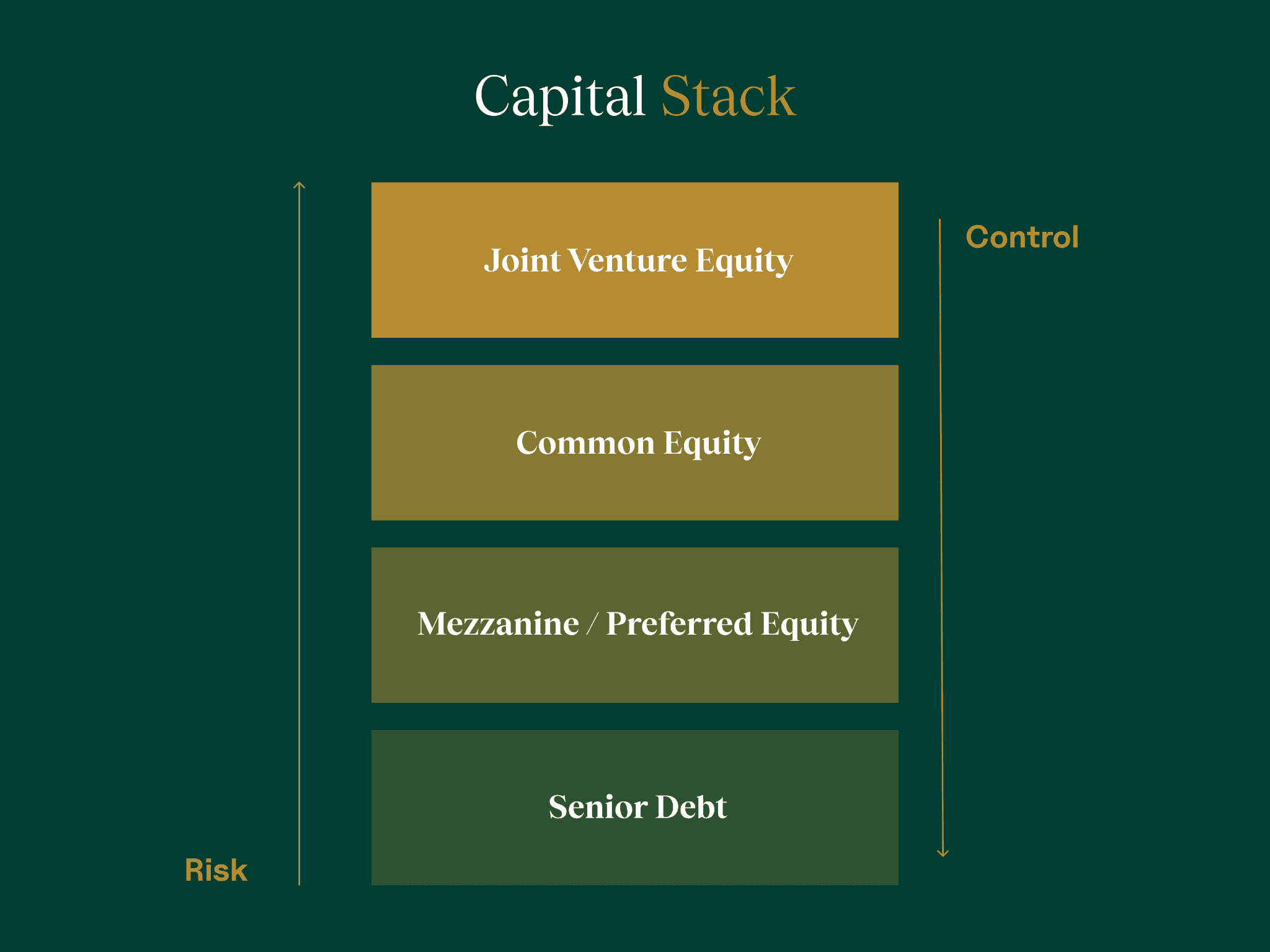
Each capital source comes with distinct risk, return, and control characteristics:
Equity: High risk, high return potential, subordinate position in distributions, voting rights and governance influence
Senior debt: Low risk, fixed return, first claim on assets, limited operational involvement
Mezzanine/preferred equity: Moderate risk, fixed or hybrid return structure, secondary claim, conversion or participation rights
Joint venture capital: Shared risk and control, co-GP or LP structures, alignment through skin-in-the-game provisions
Understanding these distinctions helps sponsors position offerings that match investor expectations.
Types of investment capital in real estate
Private equity maintains dominance in real estate investment, holding more than half of all capital commitments as of late 2023, while institutional allocations have fallen sharply since 2021. This shift reflects both macro conditions and changing investor preferences. Sponsors now operate in an environment where capital sources are less uniform and more selective about deployment strategy.
Private equity and LP commitments remain the foundation for most real estate funds. Limited partners commit capital to funds managed by general partners, accepting illiquidity in exchange for returns that exceed public market benchmarks. These commitments typically involve multi-year lockups, structured waterfalls, and performance-based incentives that align sponsor interests with investor outcomes.
Institutional capital includes allocations from pension funds, endowments, insurance companies, and sovereign wealth funds. These investors prioritize scale, stability, and governance. They conduct extensive due diligence, require audited financials, and expect institutional-grade reporting. Accessing this capital demands operational maturity and track record depth that smaller sponsors may lack.
Debt financing encompasses senior loans, bridge financing, and mezzanine debt. Senior lenders provide the largest capital tranches at the lowest cost, secured by first liens on property. Mezzanine lenders occupy the middle ground, accepting higher risk for enhanced yields and potential equity upside through conversion features or profit participation.
Joint ventures and co-GP structures allow sponsors to partner with other operators or investors, sharing both capital requirements and decision-making authority. These arrangements work well for large-scale projects where no single sponsor wants full exposure or when combining complementary expertise strengthens execution capability.
Each capital source carries trade-offs.
Private equity offers flexibility but demands high returns.
Institutional capital provides scale but imposes governance requirements.
Debt reduces equity needs but constrains operational flexibility.
Joint ventures distribute risk but complicate decision processes.
Successful firms align each capital source with their strategy, risk profile, and investor objectives.
How successful sponsors attract investors
Despite tighter markets, capital continues to flow from high-net-worth and family office channels. Family offices now allocate nearly 40% of their portfolios to real estate, a clear signal that trust and performance still attract capital to the sector.
Investors continue to deploy capital, but they are increasingly selective about whom they back.
Attracting investors depends on three core factors:
Credibility: Proven performance, verifiable track record, and professional presentation.
Alignment: Deal structures that connect manager incentives with investor return goals.
Transparency: Clear communication, open risk disclosure, and timely, accessible reporting.
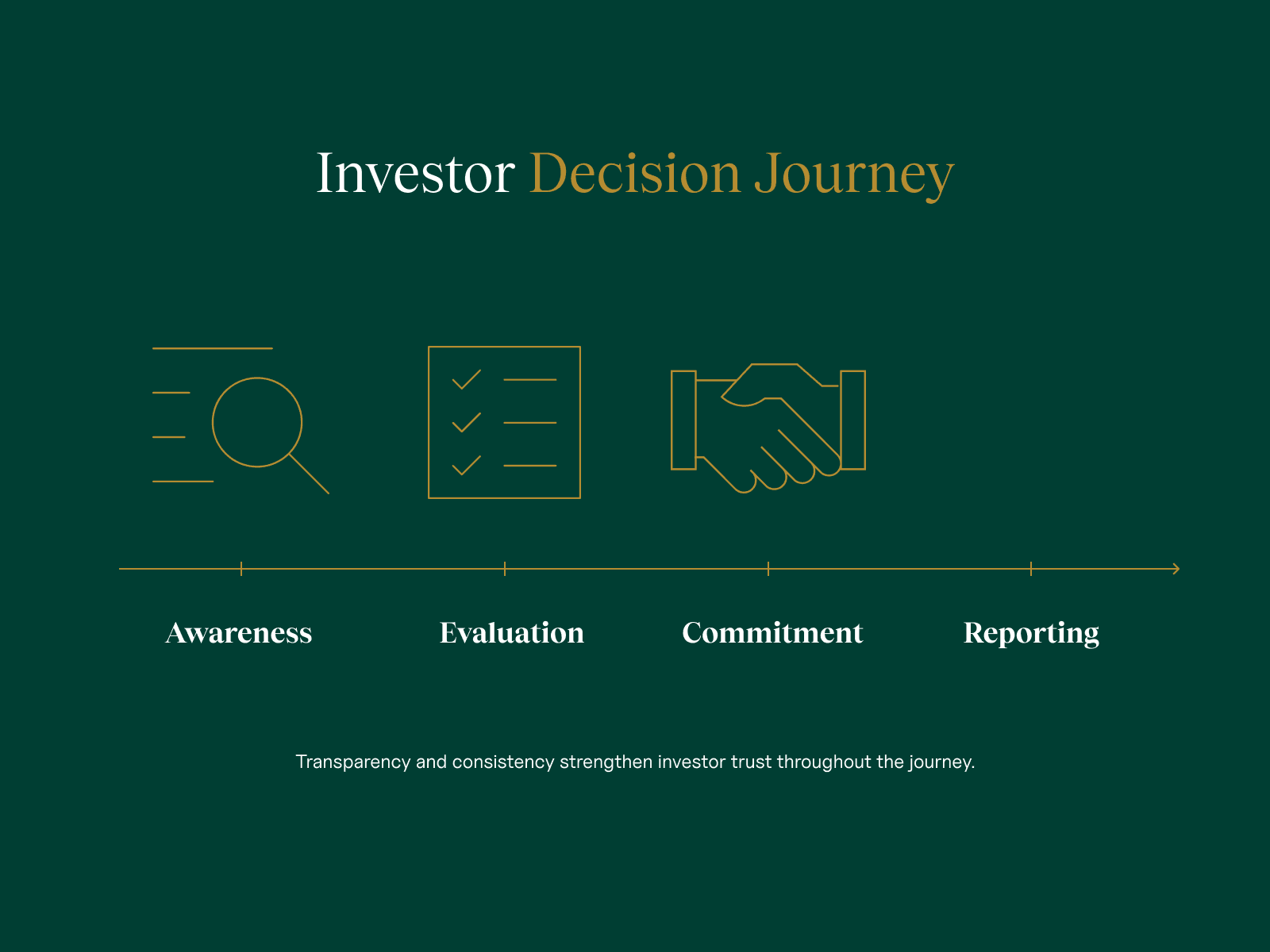
Sponsors who repeatedly close funds on target share common practices:
Clear investment thesis. Investors commit capital to strategies they understand. Vague positioning or opportunistic pivots erode confidence. Successful sponsors articulate specific asset classes, geographic focus, hold periods, and return targets. They explain why their thesis works in current market conditions and how they source, underwrite, and execute deals within defined parameters.
Transparent reporting. Quarterly reports with detailed financial statements, property-level performance data, and forward-looking commentary keep investors informed and engaged. Transparency extends beyond numbers to include challenges, market shifts, and strategic adjustments. Investors respect honesty more than perfection.
Demonstrated track record. Past performance is not a guarantee, but it is the strongest predictor of future competence. Sponsors must show completed deals, realized returns, and successful exits. For emerging managers, this might mean highlighting individual deal experience or team credentials from prior platforms.
Consistent investor experience. From first contact through distribution, every interaction shapes investor perception. Professional materials, responsive communication, and organized processes signal operational competence. Poor execution at any stage raises doubts about the sponsor's ability to manage complex real estate investments.
Structuring your investment offering
Sponsors must balance investor protection and project profitability through deliberate structuring. Preferred returns, profit splits, and compliance documentation build the foundation for investor trust and legal enforceability.
Typical fee and return structures remain consistent across private real estate funds: management fees of 1 to 3%, acquisition fees of up to 5%, and preferred returns in the 6 to 8% range. These benchmarks give investors predictable alignment frameworks and allow for meaningful comparison across competing offerings.
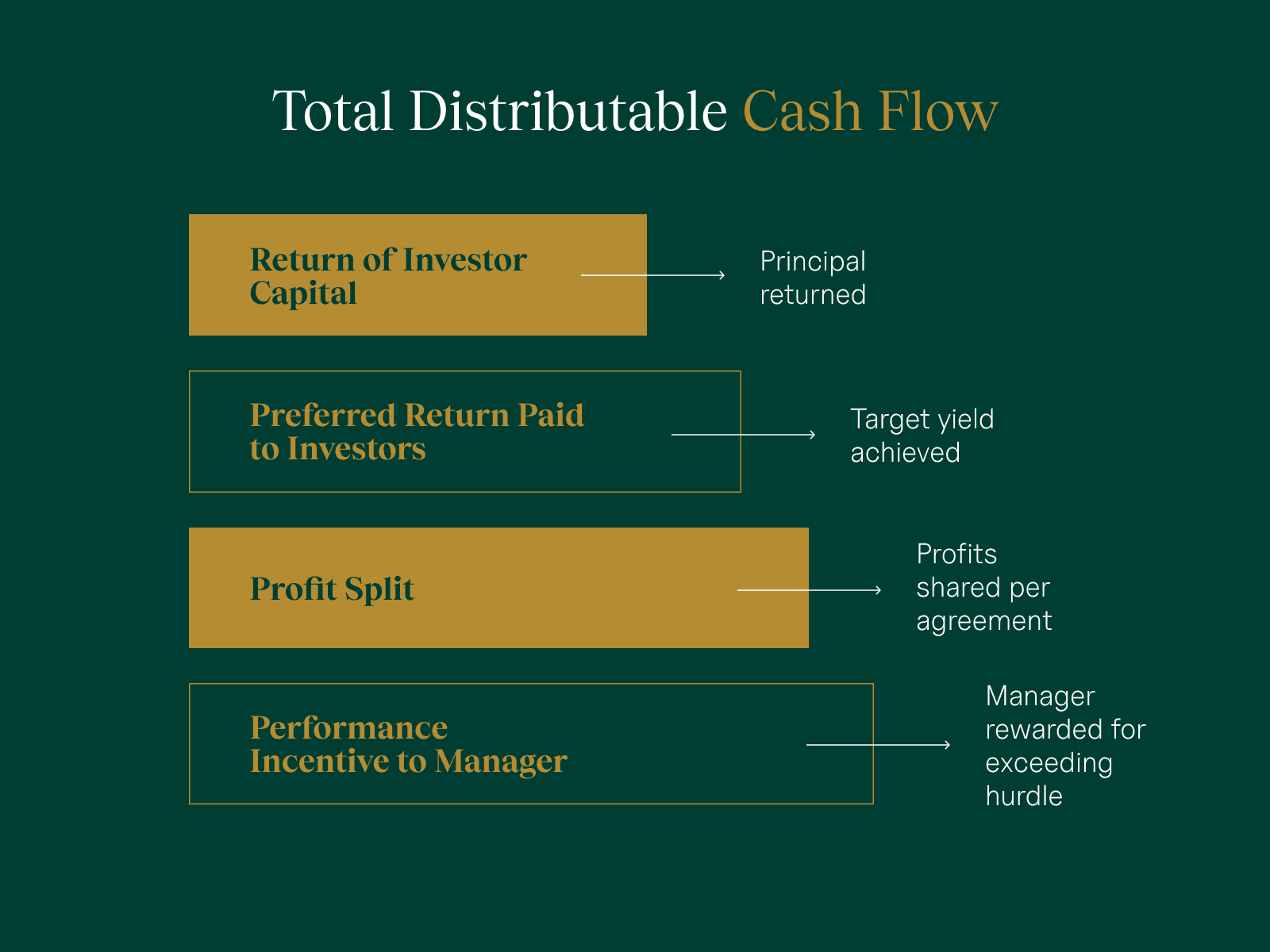
Preferred returns and equity splits establish the distribution waterfall. Investors typically receive a preferred return before sponsors participate in profits. Once the preferred threshold is met, profits split according to negotiated percentages, often with a promoted structure that rewards sponsors for exceeding return hurdles. Common splits range from 70/30 to 80/20 in favor of investors, with promote tiers adjusting based on performance.
GP/LP waterfall models govern how cash flows from operations and capital events. Standard waterfalls return investor capital first, then pay the preferred return, then distribute remaining profits according to the profit split. More complex structures may include catch-up provisions that allow sponsors to recoup their share of early distributions or multiple promote tiers tied to escalating return thresholds.
Legal documentation includes the private placement memorandum, subscription agreement, operating agreement, and investor accreditation verification. The PPM discloses risks, fees, conflicts of interest, and deal structure. Subscription agreements capture investor commitments and representations. Operating agreements define governance, voting rights, and operational authority. All documents must comply with securities regulations and accreditation requirements under Regulation D or other applicable exemptions.
Aligning interests means more than splitting profits fairly. It requires transparency around fees, clarity on decision-making authority, and mechanisms that prevent conflicts between sponsor and investor priorities. Sponsors who structure offerings with this alignment in mind attract more capital and retain it longer.
Raising capital for different real estate strategies
Different property types require different capital strategies. Institutional investors lean toward stabilized commercial assets with predictable cash flows. Private capital often favors residential and development projects where expertise and active management create value.
Residential strategies
Residential projects attract smaller investors seeking portfolio diversification and income. Multifamily properties continue to dominate institutional capital flows, representing over a third of total U.S. real estate transactions in mid-2025.
This underscores how investors remain focused on stable income-producing assets amid broader market volatility. Single-family rental portfolios and build-to-rent communities offer scale and operational efficiency that appeal to both institutional and private capital.
Commercial strategies
Commercial strategies typically focus on office, retail, industrial, and hospitality properties. Core and core-plus assets with long lease terms and credit-worthy tenants appeal to pension funds, endowments, and insurance companies seeking consistent cash flow. These assets support larger allocations and require minimal operational intervention.
Private equity investors pursue value-add and opportunistic strategies that rely on repositioning, lease-up, or selective development to capture higher yields. The distinction between these strategies lies in risk tolerance, not asset type: the same building can serve as a core investment or an opportunistic one depending on its condition, lease structure, and capital plan.
Development and mixed-use projects
These type of projects introduce construction risk and milestone-based capital deployment. Investors in these strategies expect higher returns to compensate for execution risk, market timing uncertainty, and longer hold periods.
Sponsors structure development deals with phased capital calls tied to project milestones, allowing investors to monitor progress before committing additional funds.
Matching capital source to strategy improves fundraising efficiency. Institutional investors rarely commit to speculative development without significant sponsor co-investment or completion guarantees. Private investors may embrace higher risk but expect frequent updates and clear exit visibility. Understanding these preferences allows sponsors to target the right investors for each offering.
Modern capital-raising channels
The real estate crowdfunding market, now valued at over $15 billion and growing nearly 16% annually, reflects how digital platforms have matured into serious capital-raising engines for sponsors worldwide. Technology has not replaced traditional networks but has expanded access and improved efficiency.
Crowdfunding platforms
Crowdfunding democratizes real estate investment by aggregating smaller commitments from accredited and, in some cases, non-accredited investors. Platforms like CrowdStreet, RealtyMogul, and Fundrise provide sponsor visibility, investor vetting, and transaction infrastructure. While minimum investments and fee structures vary, these platforms allow sponsors to tap distributed capital sources that would otherwise remain inaccessible.
Syndication and co-GP networks
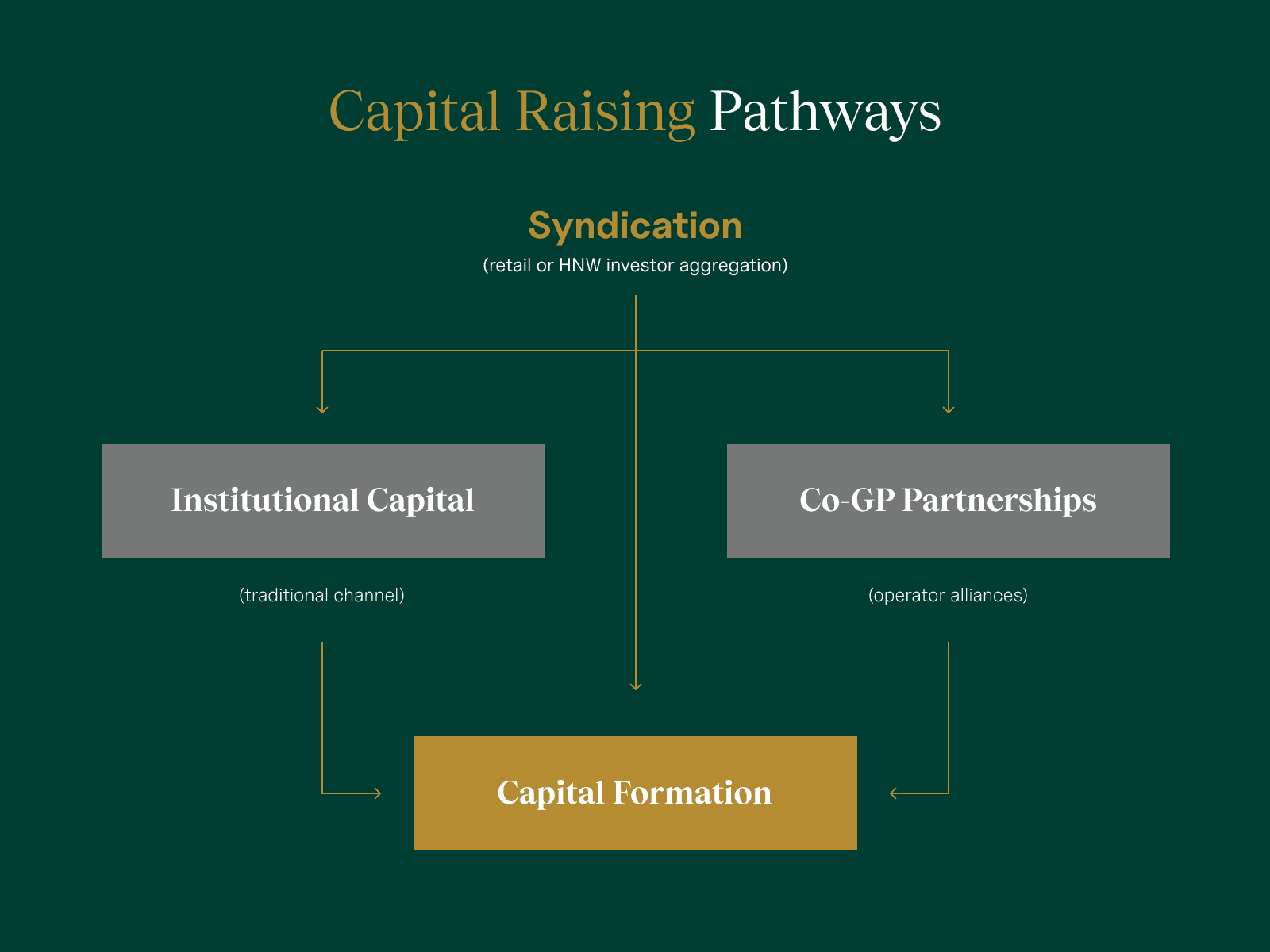
Syndication and co-GP structures have become established channels for raising capital in private real estate. Syndication pools capital from multiple investors into a single transaction, with the sponsor acting as the general partner responsible for management and execution. Co-GP arrangements bring in another experienced operator who contributes both equity and expertise, sharing responsibility for oversight and performance.
These models accelerate capital formation and expand deal capacity without relying on a single institutional backer. They also diversify exposure across multiple investors and sponsors, improving resilience in tighter fundraising environments. When structured with clear governance and transparent profit participation, syndication and co-GP networks allow managers to scale while maintaining control and alignment.
Building long-term investor relationships
Long-term relationships rely on consistent communication, transparency, and data-driven updates. Research shows that sponsors who maintain consistent quarterly or monthly reporting achieve much higher repeat-investor rates, proof that transparency directly translates into retention.
Capital raising is not transactional. The most successful sponsors view each investor as a long-term partner whose experience determines whether they commit to future offerings. Retaining existing investors costs less than acquiring new ones and creates a stable capital base that reduces fundraising friction.
Best practices for sustained investor relationships:
Quarterly reporting. Detailed financial statements, property-level performance metrics, and market commentary keep investors informed between distributions. Reports should include variance analysis, leasing updates, capital expenditures, and forward guidance. Transparency about underperformance or challenges builds trust more effectively than selective disclosure.
Clear updates on distributions. Investors expect predictable communication around cash flow and return of capital. Distribution announcements should explain timing, amounts, and sources. If distributions are delayed or reduced, proactive communication with clear explanations prevents surprises and speculation.
Proactive transparency. Address issues before investors ask. Market downturns, tenant defaults, construction delays, and regulatory changes all warrant immediate disclosure. Investors respect sponsors who communicate bad news quickly and outline corrective actions.
Personalized communication. Automated reports serve a purpose, but high-touch relationships require personal interaction. Calls with major investors, in-person meetings, and responses to individual questions demonstrate respect and strengthen loyalty. Sponsors who treat communication as relationship management, not compliance obligation, outperform peers in investor retention.
Common mistakes when raising capital (and how to avoid them)
More than half of real estate funds now close below their target size, a clear reminder that execution and investor confidence matter as much as deal quality. Even experienced sponsors make preventable mistakes that undermine credibility and extend fundraising timelines.
Overpromising returns.
Aggressive projections attract attention but create expectations that market reality rarely supports. Sponsors who consistently miss targets lose investor trust and damage their reputation. Conservative underwriting and realistic return modeling preserve credibility and allow for positive surprises.
Ignoring compliance.
Securities violations carry significant penalties and can disqualify offerings entirely. Sponsors must verify investor accreditation, follow advertising restrictions, and ensure all offering documents comply with applicable regulations. Cutting corners on compliance to accelerate fundraising creates legal exposure that far exceeds any time saved.
Weak investor updates.
Infrequent or vague communication signals either poor performance or operational disorganization. Both interpretations harm future fundraising. Consistent, detailed reporting demonstrates professionalism and accountability.
Inconsistent branding.
Professional presentation matters. Inconsistent materials, poorly designed decks, or sloppy documentation raise doubts about operational competence. Investors evaluate sponsors partly on presentation quality because it reflects attention to detail and organizational maturity.
Poor data hygiene.
Lost investor contacts, incomplete records, and disorganized files slow fundraising and create compliance risk. CRM systems and structured data management are not optional for sponsors seeking institutional credibility.
Avoiding these mistakes requires discipline, systems, and honest self-assessment. Sponsors who treat capital raising as a repeatable process rather than a one-time effort build sustainable platforms.
The bottom line
Raising capital consistently it’s about reputation, structure, and transparency. Sponsors who treat investor relations as a core competency build sustainable, scalable capital networks that survive market cycles and support long-term growth.
Private real estate has outperformed public REITs, bonds, and equities on a risk-adjusted basis over the past decade, proving that capital raised and properly delivers durable, compounding value. The sponsors who capture this opportunity are those who combine financial sophistication with operational excellence and communicate both clearly to investors.
In a market where more funds close below target than above, differentiation comes from doing the fundamentals exceptionally well.