Key takeaways
Investor reporting builds trust as much as it reports performance. Clear, consistent updates are a running test of a fund’s credibility and directly influence LP confidence and re-investment decisions.
Timeliness, accuracy, and standardization define institutional maturity. Late or inconsistent reports signal weak controls. ILPA-aligned templates and disciplined reporting cycles demonstrate professionalism and reliability.
Transparency is the foundation of alignment. Full disclosure of fees, risks, and governance practices prevents friction and reinforces fairness between GPs and LPs.
Reporting can double as marketing. When framed strategically, investor updates become subtle storytelling tools that showcase strategy execution, value creation, and firm discipline.
Technology and external partners amplify quality. Partnering with design and reporting specialists turns raw data into clear, compelling investor communications that inspire confidence.
When investors commit millions to a fund, they’re not just buying returns: they’re buying trust. Investor reporting is the formal channel through which general partners (GPs) communicate with limited partners (LPs), providing transparency into fund performance, portfolio company developments, and the deployment of committed capital. More than a compliance exercise, it’s a running test of your credibility, one report at a time.
The quality of reporting affects LP confidence and their allocation decisions. Consistent updates reduce uncertainty and show responsible management, while delays or inconsistencies quickly undermine trust.
As a result, reporting stands as a pillar of the GP–LP relationship: the timeliness, clarity, and depth of information shape expectations for ongoing communication, influence re-up decisions, and inform LP perceptions during fundraising and due diligence. This article will explore best practices, common challenges, and strategies for effective private equity investor reporting.
Why is investor reporting important?
According to a report conducted by EY, Global private equity acquisitions rose more than 40% in the first half of 2025 versus 2024, and spending on deals over $10 billion more than doubled, reaching 27%. Investors are clearly embracing risk, but with that comes heightened expectations for transparency and accountability.
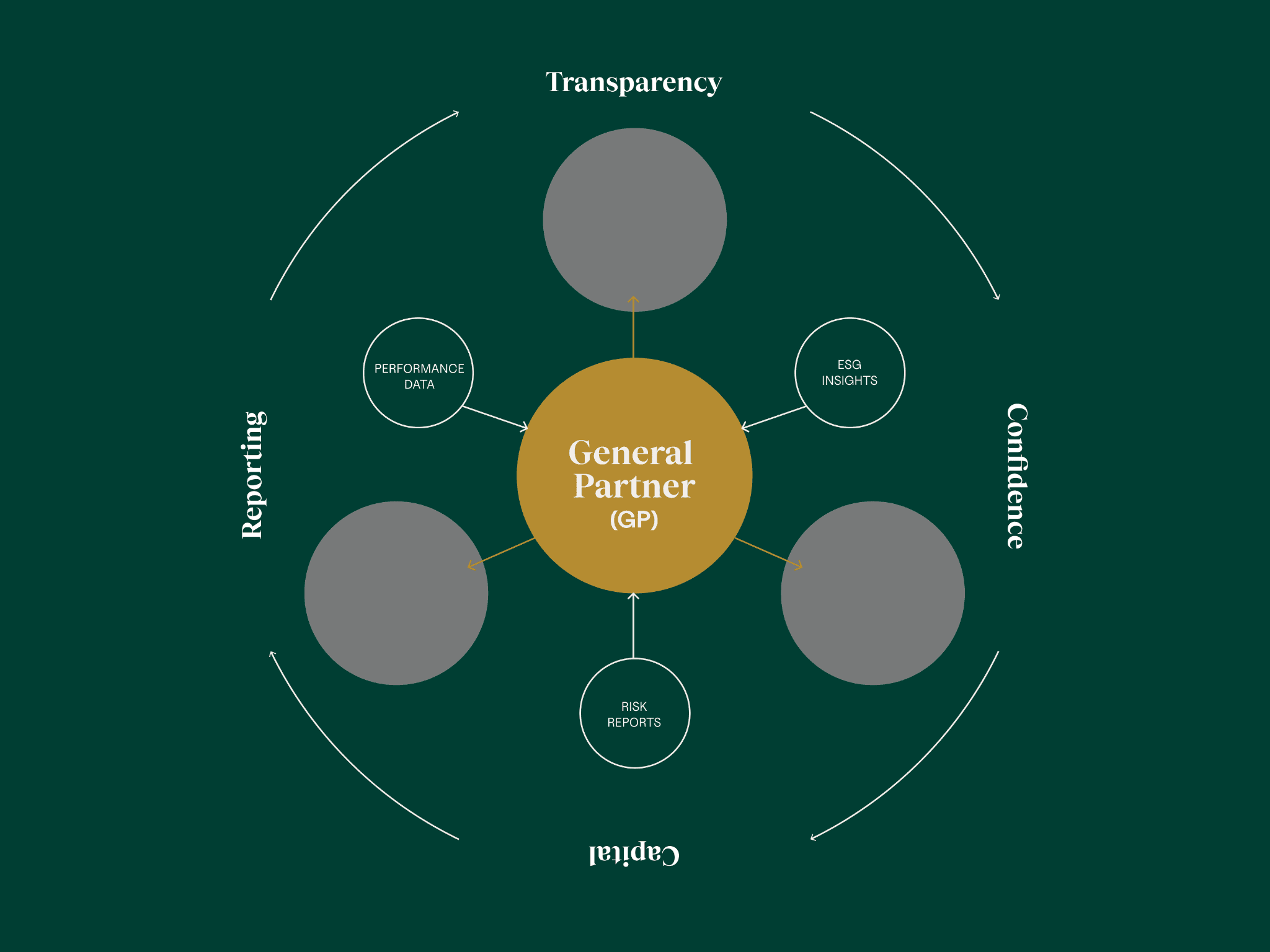
Investor reporting is more than mere numbers. A proper reporting is your pillar to capitalizing on investors’ confidence, turning their willingness to take risks into a commitment to your fund by providing a strong and continuous demonstration of performance. This transparency will be the critical factor that differentiates your fund. It assures investors you offer protected, long-term growth instead of just high risk.
By leveraging the current market growth, you can use investor reporting to give them the clarity, certainty, and security to know their capital is well-placed and fully protected.
Common types of investor reports
There are different types of recurring reports. From providing regular financial updates to offering broader context on strategy execution, each set serves a specific purpose.
Quarterly reports
Quarterly fund updates provide a timely snapshot of the fund’s overall performance and are a key component of private equity communication. They typically include financial statements, capital account summaries, and commentary on portfolio performance, along with insights into recent portfolio company developments and market conditions that may affect performance.
Why it matters: LPs get timely visibility into performance, enabling them to evaluate progress and assess short-term trends.
Annual reports
Annual reports consolidate the full-year view and go deeper into portfolio valuation, risk assessment, ESG disclosures, and governance. They often include detailed commentary on strategic initiatives, major investment decisions, and overall market positioning, providing a comprehensive picture of how the fund has executed its strategy throughout the year.
Why it matters: LPs and advisory boards get a comprehensive understanding of the fund’s overall performance, strategic execution, and governance practices.
Capital account statements
Capital account statements provide clear and detailed breakdowns of LP contributions, distributions, and carried interest allocations. Accuracy is critical to avoid disputes, and these statements often include transaction history, account reconciliations, and adjustments to ensure transparency and alignment with fund agreements.
Why it matters: Investors can clearly track their individual fund positions, monitor cash flows, and reconcile contributions and distributions with confidence.
Portfolio performance updates
Narrative updates on portfolio companies go beyond the raw numbers to provide qualitative insights into each company’s performance, strategy, and growth trajectory. These updates highlight operational drivers of value creation, including key business milestones, market positioning, management effectiveness, and execution of strategic initiatives. They may also cover challenges faced, corrective actions taken, and emerging opportunities within the portfolio.
Why it matters: LPs can gain critical context on how value is generated and where growth opportunities lie within the portfolio.
Market analysis and benchmarking
Market analysis and benchmarking reports position fund performance against broader market indices or peer groups. They provide context on relative performance, highlight trends, and offer insights into strategy effectiveness, risk positioning, and potential areas for optimization.
Why it matters: LPs gain perspective on how the fund performs compared with peers and market benchmarks, reinforcing confidence in strategy execution and long-term value creation.
For deeper insight into current private markets, see Collateral’s 2025 investment outlook.
A 2025 report revealed that 31% of LPs reduced their private equity allocations in the first half of the year, with foundations and endowments being the most affected.
(Source: Private Equity International)
4 Key components of an investor report
Investor reports must balance precision with clarity. Numbers alone rarely inspire confidence: It’s how clearly they’re communicated that earns investor trust. Beyond performance data, LPs expect disclosures that show coherence, alignment, and awareness of governance. Among the core elements, we can find:
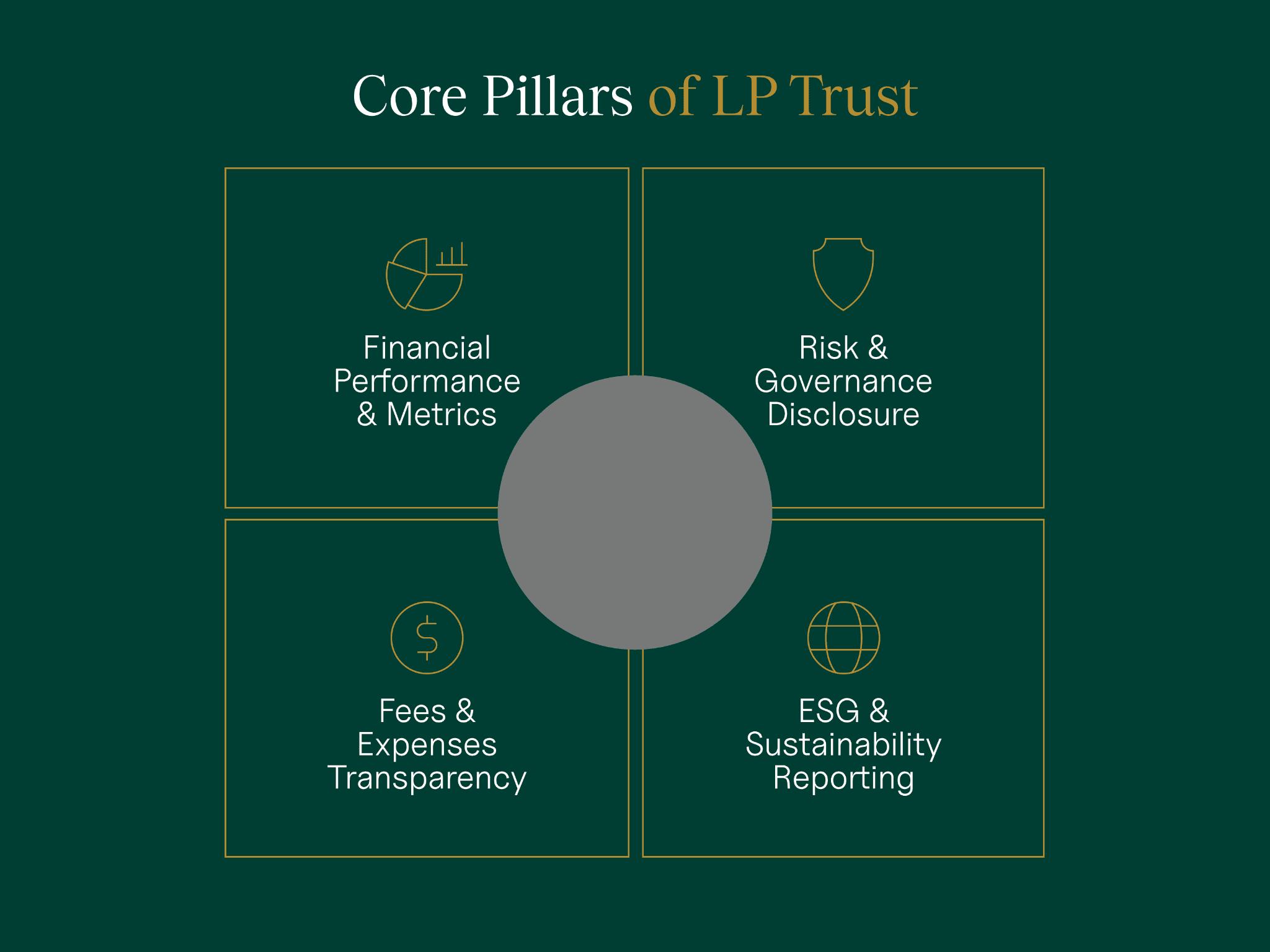
1. Financial performance and metrics
Clear reporting of NAV, IRR, DPI, and other fund metrics is essential. Consistency in calculations ensures that results are comparable across funds and reporting periods. Reliable, standardized metrics provide a fair assessment of performance.
2. Risk assessment and governance disclosure
LPs look for forward-looking commentary on risks, paired with evidence of strong governance and compliance oversight. This signals active management of capital and controls. Besides, demonstrating risk awareness helps position the GP as a fiduciary with strong governance and control. Some firms can also benefit from external partners, who provide strategic positioning services to strengthen governance communication.
3. Fees, expenses, and carried interest
Transparent disclosure of fees, fund expenses, and carried interest builds trust. Ambiguity in this area is a frequent source of LP frustration and scrutiny. Full clarity avoids disputes and reinforces alignment of interests.
4. ESG and sustainability reporting
Not yet universal, but increasingly expected. Including ESG data shows maturity and responsiveness to institutional priorities. Even brief disclosures can strengthen perceptions of credibility and operational sophistication.
Compliance and reporting standards
Beyond financial clarity and portfolio updates, the true strength of investor reporting lies in its alignment with institutional standards.
Investors today don’t just want performance, they want assurance that the fund operates with transparency and accountability. This is where reporting quality and compliance converge.
Adhering to recognized frameworks and regulations demonstrates institutional maturity and reassures investors that your fund operates with a strong accountability. Strong compliance practices not only reduce regulatory risk but also streamline fundraising, giving LPs the confidence that your reporting meets the highest industry standards.
The following guidelines define today’s best practices in investor reporting.
ILPA principles and guidelines
The Institutional Limited Partners Association (ILPA) provides frameworks that many LPs reference as a baseline. Adherence to ILPA templates signals alignment with best practices and helps standardize fee, performance, and governance disclosures. Using ILPA formats also reduces back-and-forth with LPs by delivering information in a structure they already know and trust.
Regulatory expectations (SEC, AIFMD, local rules)
Compliance obligations vary across jurisdictions. In the U.S., the SEC emphasizes transparency on fees, expenses, and conflicts of interest. In Europe, AIFMD requires detailed reporting on leverage, liquidity, and risk. Local regulators may impose additional rules, making a consistent global reporting framework essential to avoid errors and gaps.
Alignment of interest and transparency requirements
Both regulators and LPs prioritize alignment between GP and LP. Clear disclosures on fees, expenses, and governance demonstrate fairness and reduce friction during diligence. By proactively sharing this information, firms can prevent misunderstandings and build credibility as transparent, institutional-grade managers.
Common compliance pitfalls to avoid
Even well-intentioned firms can stumble if their internal processes aren’t robust. Common issues include:
Inconsistent fee reporting across funds
Incomplete or omitted risk disclosures
Delayed filings that attract the regulator's attention
Poor version control leading to data errors
Overreliance on manual processes without adequate checks
A thorough process, robust systems, and a culture prioritizing reporting accuracy can help avoid these pitfalls. The cost of compliance mistakes extends beyond fines: reputational damage affects fundraising for years.
Investor reporting: turning updates into a marketing opportunity
When executed with clarity, precision, and strategic framing, investor reporting doesn’t just inform: it persuades. It’s the quietest yet most powerful form of marketing your fund will ever do.
Well-crafted reports are not obligations or costs: they are advantages. They build trust, strengthen your firm's narrative, and showcase professionalism. Think of investor reporting as part of your marketing strategy. It reinforces your message, showcases your story, and highlights what makes you unique. Unlike traditional marketing channels, this guarantees an engaged audience: investors carefully read your updates.
To maximize impact, let professionals handle your reporting. External partners can help you transform complex data into compelling reports, highlighting your firm’s strengths and reinforcing your core narrative. Reports that effectively communicate strategic decisions and value creation increase investor confidence in your execution, often leading to greater commitments and expanded allocations.
Practical tips to maximize fundraising impact through reporting:
Use storytelling: Frame portfolio updates around strategy execution and value creation, not just numbers.
Highlight key wins and lessons learned: LPs value insights into both successes and corrective actions.
Provide standardized metrics: Facilitate easy benchmarking for investors across funds and periods.
Segment reporting for different LP audiences: Tailor detail levels for institutional LPs vs. smaller investors to demonstrate attentiveness.
Leverage visuals and dashboards: Clear charts and infographics make complex data digestible and memorable.
Real case study: Fort Capital, from reports to results
When Fort Capital, a U.S.-based real estate private equity firm, began preparing to raise its next institutional fund, it faced a familiar challenge: its reporting materials no longer reflected the sophistication of its investment strategy. Despite a strong track record in value-add and opportunistic property investments, its quarterly reports and investor decks lacked the consistency, depth, and visual clarity that large LPs expect.
To address this, the firm brought an external partner to develop a comprehensive communication strategy that combined market research, portfolio data visualization, and institutional-grade reporting design. The new materials clarified Fort Capital’s investment thesis, showcased its track record with clear metrics, and articulated how its acquisition and asset management approach created value across cycles.
The outcome was transformative: Fort Capital strengthened its credibility with prospective limited partners, improved investor engagement during due diligence, and positioned itself as a fully institutional-ready manager.
Read the full case study to see how strategic reporting elevated Fort Capital’s investor communications and fundraising success.
Common challenges in investor reporting
However, the investor reporting process is not always smooth. Even experienced firms face obstacles in producing consistent, high-quality reports. Limited resources, data complexities, and tight deadlines can strain teams and expose gaps in oversight. To meet these demands effectively, it’s important to understand the most common challenges firms encounter and how to address them proactively.
Data management and accuracy
Accurate investor reporting begins with reliable data. Without strong processes, even small errors undermine credibility with LPs. Maintain clean, well-structured data for reliable reporting. Minimize manual processes to reduce error risk and compliance concerns. Apply strong data governance to prevent mistakes from damaging LP relationships.
Timeliness of reporting
Deadlines are as important as data. Late reports erode trust and suggest weak internal controls, while delivering reports on schedule preserves credibility. Timely reporting respects investors' decision-making needs. Late reports may suggest operational weakness or poor internal controls, raising concerns that extend beyond the immediate delay.
Consistency across funds and formats
LPs value consistency across materials. A standardized approach reduces confusion and reinforces professionalism. Standardize presentation across multiple funds to minimize LP effort in analysis. Maintain uniform formatting to demonstrate organizational rigor. Consistent reporting practices position the firm as institutional-grade and prepared for scale.
Communication with LPs
Strong reporting means little if follow-up communication fails. Respond promptly and consistently to questions and inquiries. Support investor relations teams in reinforcing report impact. Poor post-report communication creates friction and weakens relationships that strong reports worked to build.
Valuation of illiquid assets
Valuing illiquid holdings remains one of the toughest challenges in private equity reporting. Transparency is key to maintaining trust. Apply rigorous methods to value private, illiquid assets accurately. Address methodological differences, assumptions, and limited comparables transparently. Disclose valuation challenges clearly to maintain LP confidence in reporting reliability. LPs understand that private asset valuation involves judgment; what they cannot accept is opacity.
Best practices for private equity investor reporting
Best practices in reporting go beyond regulatory compliance. They reflect a GP’s ability to communicate effectively, instill confidence, and strengthen LP relationships. The following practices serve as a guide for delivering information that is both accurate and impactful:
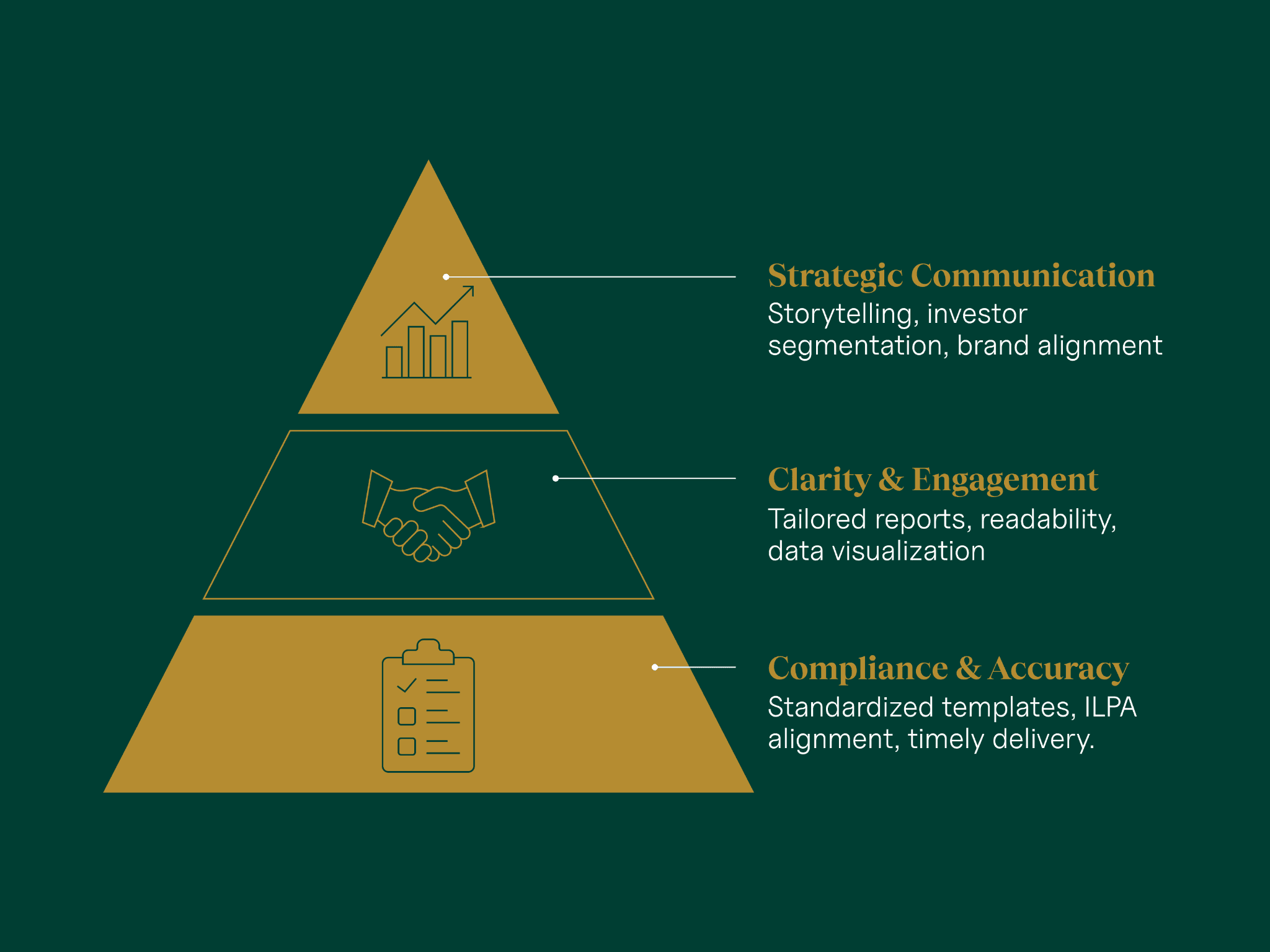
1. Standardization and templates
Using standardized templates (ILPA-aligned where possible) reduces ambiguity, saves time, and minimizes errors. A consistent reporting format also helps LPs benchmark across funds more efficiently.
2. Clarity in financial disclosures
Avoid jargon. Present financials in a way that LPs can digest without unnecessary interpretation. Clear labeling and explanations of metrics reinforce credibility and reduce back-and-forth questions.
3. Tailoring reports to LP expectations
Large institutional LPs may expect greater detail than smaller investors. Segmenting reporting where appropriate strengthens relationships and shows attentiveness to LP priorities. Customization signals maturity in investor relations.
4. Balancing detail with readability
Overly long reports weaken key insights. Focusing on material information keeps attention on what matters, while appendices or data rooms can provide deeper context. This balance helps maintain engagement without overwhelming readers.
Bottom line
In a competitive fundraising environment, the ability to articulate not only the numbers, but why they matter and how they support future growth becomes a differentiator. Strong reporting doesn’t just inform investors but positions the firm as forward-thinking, data-driven, and strategically aligned with LP objectives.
External partners can help firms turn complex data into clear reports, quarterly updates, and portfolio communications that build LP confidence and showcase operational excellence. Investor loyalty is your most valuable asset. Build it through professional reporting and cultivate long-term trust