Key takeaways
The real handover was 2017. KKR's co-president appointment was the operative succession, not 2021
2. Named successors aren't the point. Distributed authority across IC, LPs, and deal flow is what matters
Succession is architecture, not announcement.. The window to build it opens earlier than most GPs realise
Fund I decisions determine Fund III conversations. LP questions about key-person risk reflect structure built years earlier
The succession event the market missed
In October 2021, KKR announced that Joe Bae and Scott Nuttall would replace Henry Kravis and George Roberts as co-chief executive officers. Coverage was extensive, tone was reverential, and the financial press treated it as a landmark moment in private equity history.
It wasn't. The landmark happened four years earlier. In KKR's own published account of the transition, Kravis is explicit: "Our real succession event we internally point to was when they were appointed co-presidents in 2017." The 2021 announcement was the governance certificate.
That detail is the more useful version of the KKR story, particularly for allocators evaluating founder-dependency risk and the GPs who field those questions during a raise.
A stress test with a safety net
When Bae and Nuttall were named co-presidents in July 2017, Kravis and Roberts remained nominally in charge. What followed was an unusually well-documented rehearsal: new leadership ran the firm while the founders provided cover, and the market watched. Between 2017 and 2021 AUM more than doubled, distributable earnings more than doubled, and KKR's stock price tripled.
Bae and Nuttall’s four-year co-president period forced them to demonstrate that they could grow the firm without the founders in the decision seat. It was long enough to be a genuine test and structured enough to be credible to LPs. By the time the 2021 announcement landed, Citigroup analysts called it "orderly" and expected no disruption to AUM or earnings. They were right, because the transition risk had already passed.
Bae described what the firm looked like before any of this existed. In an August 2024 Fortune interview, he recalled the early IC process: "Back then, Henry Kravis and George Roberts were the de facto investment committee. The process was that after studying the transactions, you walk into Henry's office, then you call George, and then you talk about the deal."
By 2017, that process no longer existed. The firm had grown too large and too distributed for two people to remain the bottleneck.
Two decades of structural decoupling
The 2021 governance changes — co-CEO structure, dual-class share elimination — were outputs. The inputs span nearly two decades, documented in KKR's public filings and the firm's own disclosures:
2000: KKR Capstone launched with operational consulting working exclusively across portfolio companies, separating value creation from the founders' dealmaking.
2004: Credit platform launched — initially to support deal financing, eventually becoming the firm's largest segment by AUM.
2005–06: Asia expansion under Bae, building a dedicated platform independently of New York.
2007: KKR Capital Markets launched, enabling the firm to underwrite its own debt and equity without external bank dependency.
2010: NYSE listing, bringing public reporting standards, quarterly earnings obligations, and institutional governance expectations.
2017: Bae and Nuttall named co-presidents with explicit, divided accountability — Bae owning global private equity and real assets, Nuttall owning strategy, capital markets, insurance, and the balance sheet.
Each move reduced the load carried by any single relationship or person. By 2017, KKR's fee income, AUM, and deal flow ran across credit, equity, infrastructure, real estate, Asia, Europe, and capital markets — none of which depended on a bilateral conversation between two cousins. That's what was institutionalised: the progressive decoupling of the firm's revenue, decision-making, and LP relationships from any two people's judgment.

The three questions allocators should be asking
Succession readiness is now a decisive factor in re-up decisions for 96% of LPs, yet fewer than half of GPs have a formal transition plan. Allocators are raising the question. But most GPs are answering the wrong version of it.
Most LP due diligence asks: "Do you have a succession plan? Who are your named successors?". That framing locates risk in personnel rather than structure.
The sharper diagnostic runs across three distinct exposures:
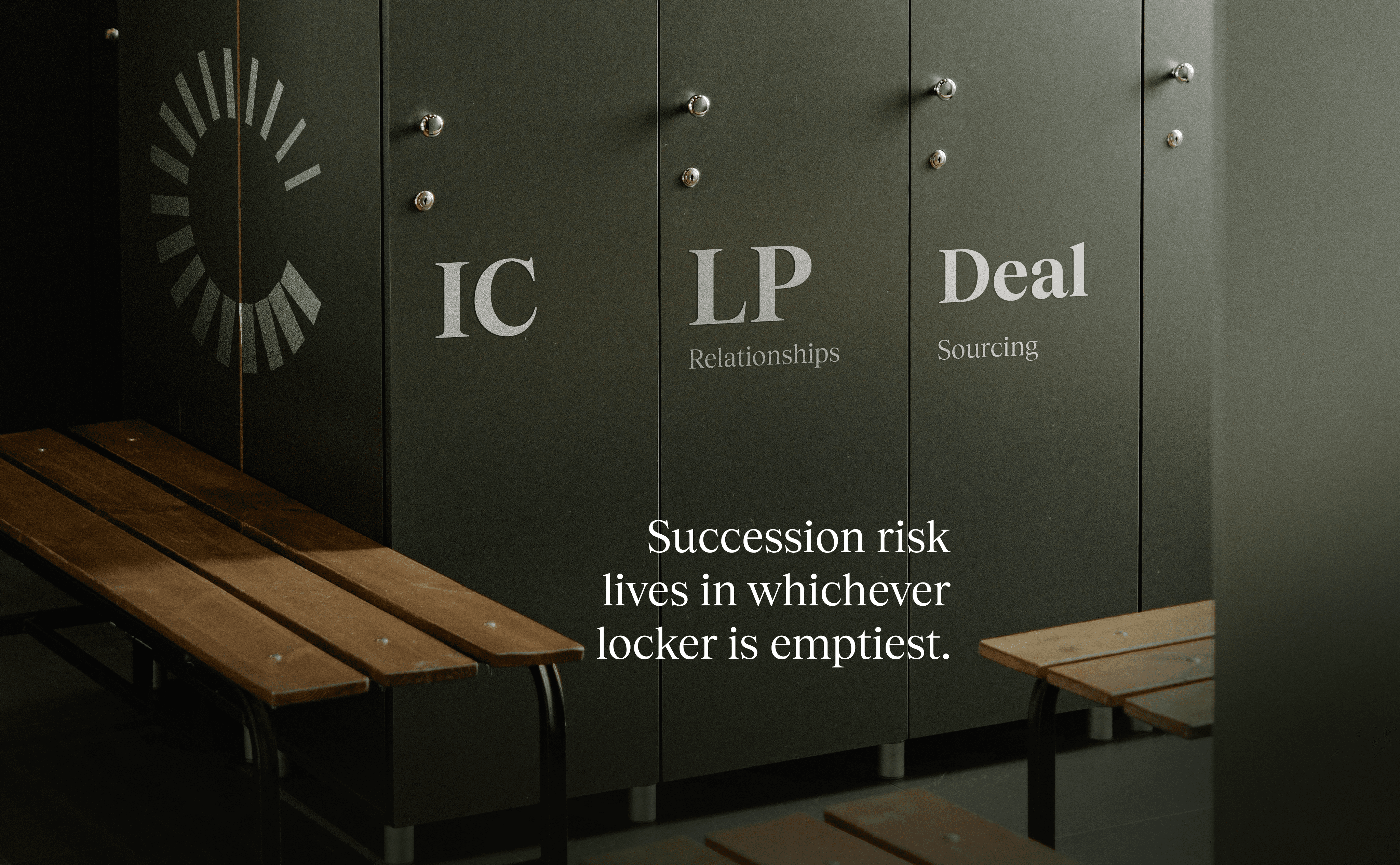
IC authority. If the founding partner left tomorrow, who has established decision-making standing on the investment committee? Is that standing documented and tested, or is it informal and contingent on presence?
LP relationships. Are allocator relationships held at the firm level or the individual level? A GP whose investors call the founding partner's mobile first has a concentration problem regardless of what the org chart says.
Capital deployment. Can the firm source, underwrite, and close deals without the founder in the room? The answer depends on whether deal sourcing — networks, sector expertise, origination channels — is distributed across a team or sits with one person.
KKR could have answered all three cleanly by 2017. Most funds raising today cannot. How that reads to a skeptical allocator is one of the more consequential things a GP can pressure-test before entering a raise.
Scale and time are the two variables most GPs don't have
KKR's timeline spans roughly two decades. Bae and Nuttall joined in 1996, 25 years before becoming co-CEOs. The relationship infrastructure underpinning their co-leadership was built across hundreds of joint decisions and several market cycles. Kravis noted that their friendship mirrored his own with Roberts. That's not replicable on a compressed timeline.
A fund with $2 billion AUM cannot list on the NYSE to force governance formalisation, build a capital markets subsidiary, or sustain an operational consulting arm. The mechanisms KKR used required scale and duration that most managers don't have.
The principle transfers. The mechanism often doesn't. What does transfer is the logic of sequencing:
Begin distributing IC authority
Build LP relationships
Do deal sourcing before the market forces the question
The specific tools vary by strategy and stage. A credit manager might do this through a deputy with independent IC standing and dedicated LP coverage; a real estate platform through sector teams with autonomous underwriting authority. The form differs but the intent is the same.
At fund launch or Fund I
The decisions that look inconsequential at launch or at Fund I tend to be the ones that calcify into structural problems by Fund III. Two moves matter most at this stage:
First, avoid concentrating all external LP relationships with a single founder. Even if that founder is the primary relationship driver, a named senior team member should be present in LP meetings from the beginning and introduced with substantive context, not as an add-on.
Second, document the investment committee framework explicitly, even if it currently functions as one or two people's judgment. The ILPA DDQ 2.0 asks detailed questions about IC composition, decision rights, and succession of roles. Answering those questions credibly later requires having built the structure, not having invented it for the DDQ response.
At mid-cycle, building toward a subsequent fund
This is the stage where distribution of authority either gets built or gets deferred indefinitely. Three things to address before the next raise:
IC standing: At least one senior professional below the founding partner should have a documented and exercised vote on investment decisions. If that person has never presented or led a deal to close, the IC authority is nominal rather than real.
LP relationship coverage: Map which LPs have meaningful relationships with team members other than the founding partner. If the answer is few or none, begin introducing a named partner into LP reporting, annual meetings, and one-on-one calls, not as a courtesy, but as a deliberate handover of relationship equity.
Deal sourcing: Track where deal flow originates. If it routes almost entirely through the founder's personal network, that's the single most important structural risk to address. Building sector-specific origination through junior partners or dedicated coverage takes time; starting in Fund II is materially better than starting in Fund III.
When succession becomes a live conversation
By the time an LP directly asks about succession in diligence, the structural work should already be demonstrable rather than projected. A well-prepared GP at this stage can point to:
A co-investment or lead role carried by a named successor on at least two or three completed deals
LP relationships with documented coverage by non-founding partners
An IC process where the founding partner's presence is influential but not logistically required.
The difference between a firm that has built this and one that hasn't shows up in the specificity of the answer. Vague succession language — "we have a strong team" — reads to an experienced allocator as the absence of a plan.
None of this compresses two decades into two years. But it reframes what "succession planning" actually means for a firm that can't replicate KKR's institutional depth: not a document or a named successor, but a series of structural decisions made early enough to matter by the time anyone is asking.
Bottom line
Here is what the KKR case reveals that most succession planning conversations don't reach: the window to build this is structural, not calendrical. It can't be opened by naming a successor or drafting a transition document. It opens when a firm makes decisions — about IC structure, about who owns which LP relationships, about how deal sourcing is organised — that distributes authority before anyone is asking.
Most GPs discover this too late. The LP across the table asking about key-person risk in a Fund III raise is, in practice, evaluating decisions the GP made in Fund I and Fund II. Those decisions are either already in the structure or they aren't.
A well-constructed fund presentation can surface distributed authority that already exists, but it can't manufacture what wasn't built. How that authority is articulated — across team structure, IC governance, and LP relationship depth — is precisely where materials do real work. KKR didn't plan a transition. They built a firm that eventually made one unnecessary.